
Sewage connection set for water softeners


€89.00
Available, delivery time: 1-3 days
Abwasseranschlussset für Wasserenthärter DN40 von Aqmos mit Luftsperre und Rückschlagkappe.
Product information "Sewage connection set for water softeners"
The Sewage protection Valve is used for contact-free water drainage into the sewer network. By connecting the overflow protection and waste water hose to two valves that rotate 180 °, there is no splash of water when it drains off. The air barrier ensures that the waste water does not come into contact with the waste water hose. This means that no bacteria from the sewage system can get into your drinking water pipe. Bacteria cannot be transmitted through the air.
The waste water protection valve is placed vertically on the sewer connection. As soon as the water flows through the two hoses (overflow protection and waste water hose), the resulting water pressure opens the valve and the water can easily run into the waste water pipe.
The valve then seals again automatically. This means that the water does not flow back and unpleasant smells and any bacteria that may develop in the hose are avoided.
More information:
Flow cleaning: 30 l / min
Material: polypropylene
vertical discharge: 120.9 l / min
Material: polypropylene, white
Note: Do not use a drain cleaner on this product.
Ladenkiste UG (haftungsbeschränkt)
Bahnhofstr.
34286
Spangenberg
Deutschland
kontakt@wasserfilter-zentrum.de
Related items

Drinking water softening system in a cabinet housing with English menu navigation, color display for faster recognition of operating conditions & control head from Clack. NEW - Clack control head with German menu and color display. The color modes of the display make it easier to check the operating status (blue = everything is OK). If there is an error (red = malfunction), you can see it at a glance. The German menu makes setting up the system a lot easier. Other languages: English, French, Spanish, Polish. The WatPass® water softening systems are a real innovation. They work according to the ion exchange method. This procedure is the establishment test for water softening. Our systems are available in 2 variants: 1. Standard salting for normal households Best sensory result and adequate softening for the entire household. The WatPass® lime is particularly energy-saving! By salting the regenerating salt is used optimally. If you are using the system for technical applications, please note the following values ??when cutting. A perfect wash result for glasses is available at values ??of <150 µS / cm and for cutlery, the system should be set to <80 µS / cm. Your advantages: • no calcified heating rods & spray nozzles • better energy utilization of the devices 2. Swiss version For operation in Switzerland, the SVGW regulation must be observed. Therefore, the systems for Switzerland are supplied with nylon protective sock and silver resin. Otherwise, the system is designed as the standard version! Nylon protective stocking / fine salt: Normally, softening plants in Switzerland are used with fine salt instead of salt tablets. Water softening systems that we deliver to Switzerland are therefore equipped by us with a nylon protective stocking so that you can operate the softening systems with fine salt. As a result, a blocking of the salt in the system is excluded. Silver resin content (min 2%): The ion exchange resin must contain a minimum of 2% silver resin. Regeneration with ion exchange resin - how does it work? When hard water is passed over the resin, the calcium and magnesium ions (Ca2 + / Mg2 +) present in the water are exchanged for the sodium ions (Na +) present on the resin. The resin we use has a lifespan of over 20 years. Your advantages Softer water protects your installations, the heating system, washing machines and small appliances such as kettles and coffee machines. The limescale deposits on your shower enclosure, washbasins, toilets, etc. are greatly reduced. You can save significant amounts of detergent, soaps and shampoo and the water just tastes better. Especially tea lovers, coffee drinkers and ambitious home cooks will appreciate the result of softened water. Anyone who has used a water softening system would never want to do without it again. When does it make sense to use a water softening system? The DIN 1988-200 recommends in Table 6 above a hardness of 2.5 mol / m³ (14 ° dH) for drinking water cold hardness stabilization or softening. The water is not fully softened for drinking water purposes, but by means of the mounting block to a water hardness of about 6-7 ° dH, if technically possible, blended. If the water is even softer, it can become corrosive and thus pose a problem for the installations. Moreover, it does not taste that good either. Construction of water softening systems WatPass® A cabinet housing with removable lid, in which a GFK pressure bottle (filled with ion exchange resin) sits, form the basis for the extremely low-maintenance Clack control valve with color display and German operation. This is a real innovation and makes the handling of the system a lot easier. The system is of course volume controlled. The innovative valve can be disassembled and maintained completely without tools. Regeneration - what is it? If the pre-set volume of soft water flow is reached, regeneration of the resin will be triggered at 2:00 am. A reserve capacity is programmed by us as a safety factor in the unit, so that lime-free water is available after the pre-set water capacity has been reached, until regeneration. During regeneration, the water softener automatically routes saline (sodium chloride) through the ion-exchange resin. In this process, the resin is again afflicted with sodium ions (Na +). The calcium and magnesium ions (Ca2 + / Mg2 +) are derived with the saline solution via a separate drain port. Now the resin is ready to re-soften your drinking water. During regeneration, the WatPass® 320 delivers untreated tap water, so that the water supply is given. In case of inactivity of the plant (eg vacation) a compulsory regeneration is triggered every 10 days to prevent the germination of the resin bed. How long does a filling of salt last? Depending on the water hardness and your water consumption, a filling is enough for about 3-4 months, then new salt must be refilled. The integrated safety float valve protects you from overflowing water System size and technical information For households up to: 1-3 persons Water softening system WatPass® Kalk 3200 with volume control Control valve: Clack WS 1 with color display and German menu navigation (quantity-controlled) Capacity at 10 ° dH .: 3,200 ltr. Capacity at 15 ° dH .: 2,130 ltr. Capacity at 20 ° dH .: 1,600 ltr. Pressure Tank Type: 8x17 Resin content: 8 liters Salt consumption per regeneration: approx. 1.28 KG Regeneration duration: approx. 60 min Salt stock .: 40 KG Block dimension (HxWxD): 670 x 320 x 500 mm Weight: 13 Kg The WatPass® Kalk 320 water softening system consists of: A cabinet housing for a salt supply. A volume-controlled central control valve type Clack WS 1 CI IA, with English menu navigation and color display. Integrated in the system, a GRP pressure bottle filled with high quality ion exchange resin. Installation conditions for all plant sizes: Drinking or raw water connection Socket 230 V / 50 Hz Waste water connection Pressure reducer at> 6 bar Domestic water filter at the entrance Connection thread: 1 inch frost-free installation site If you need a plumber, we can arrange for you a specialized specialist company for the area of Central Germany, where you usually get an appointment within 2-4 weeks. The costs are performance-related and are negotiated by you directly with the executive specialist. Details on the installation situation will be clarified in advance. We receive no commission for the mediation! Please contact us if this service is interesting for you. For the installations according to DVGW guidelines, a DVGW certified pipe separator is available on request (not required for own well). The plant is delivered by freight carrier. Please tell us when ordering necessarily a phone number under which you can be reached on delivery.
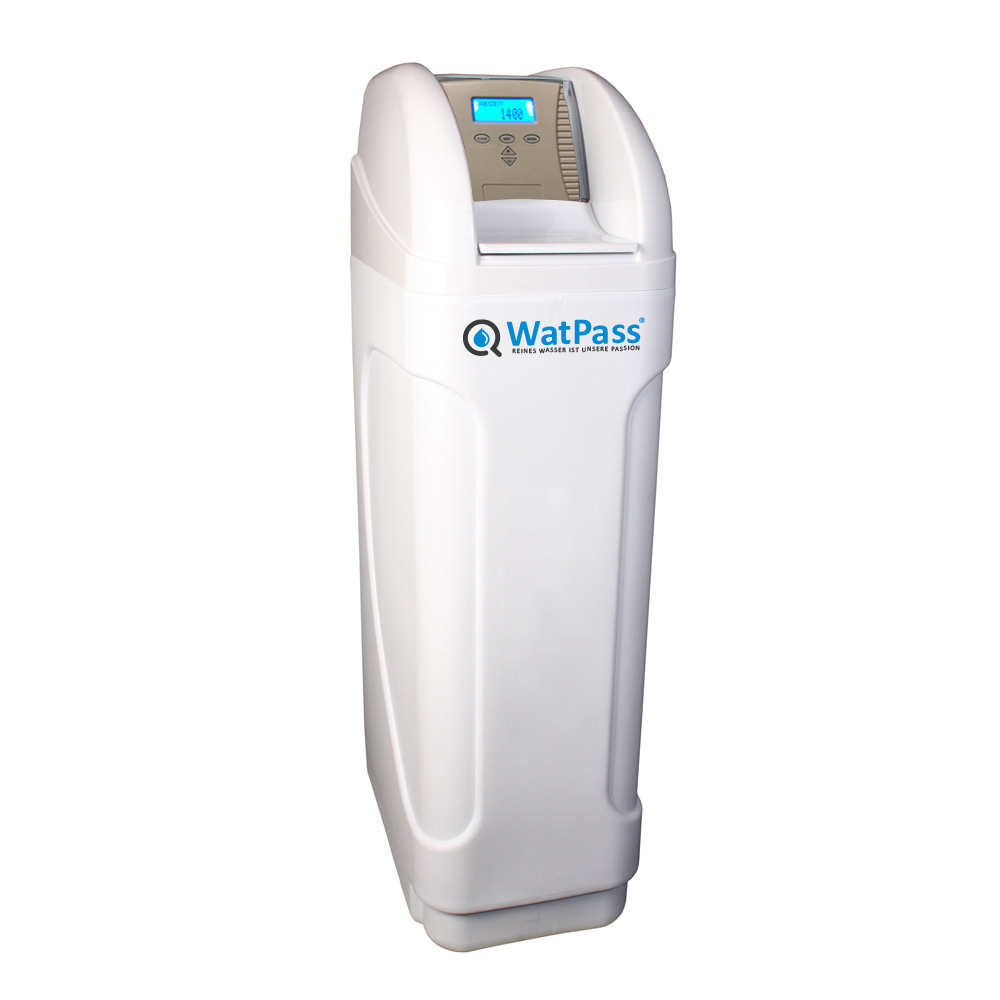
Drinking water softening system in a cabinet housing with English menu navigation, color display for faster recognition of operating conditions & control head from Clack. NEW - Clack control head with German menu and color display. The color modes of the display make it easier to check the operating status (blue = everything is OK). If there is an error (red = malfunction), you can see it at a glance. The German menu makes setting up the system a lot easier. Other languages: English, French, Spanish, Polish. The WatPass® water softening systems are a real innovation. They work according to the ion exchange method. This procedure is the establishment test for water softening. Our systems are available in 2 variants: 1. Standard salting for normal households Best sensory result and adequate softening for the entire household. The WatPass® lime is particularly energy-saving! By salting the regenerating salt is used optimally. If you are using the system for technical applications, please note the following values ??when cutting. A perfect wash result for glasses is available at values ??of <150 µS / cm and for cutlery, the system should be set to <80 µS / cm. Your advantages: • no calcified heating rods & spray nozzles • better energy utilization of the devices 2. Swiss version For operation in Switzerland, the SVGW regulation must be observed. Therefore, the systems for Switzerland are supplied with nylon protective sock and silver resin. Otherwise, the system is designed as the standard version! Nylon protective stocking / fine salt: Normally, softening plants in Switzerland are used with fine salt instead of salt tablets. Water softening systems that we deliver to Switzerland are therefore equipped by us with a nylon protective stocking so that you can operate the softening systems with fine salt. As a result, a blocking of the salt in the system is excluded. Silver resin content (min 2%): The ion exchange resin must contain a minimum of 2% silver resin. Regeneration with ion exchange resin - how does it work? When hard water is passed over the resin, the calcium and magnesium ions (Ca2 + / Mg2 +) present in the water are exchanged for the sodium ions (Na +) present on the resin. The resin we use has a lifespan of over 20 years. Your advantages Softer water protects your installations, the heating system, washing machines and small appliances such as kettles and coffee machines. The limescale deposits on your shower enclosure, washbasins, toilets, etc. are greatly reduced. You can save significant amounts of detergent, soaps and shampoo and the water just tastes better. Especially tea lovers, coffee drinkers and ambitious home cooks will appreciate the result of softened water. Anyone who has used a water softening system would never want to do without it again. When does it make sense to use a water softening system? The DIN 1988-200 recommends in Table 6 above a hardness of 2.5 mol / m³ (14 ° dH) for drinking water cold hardness stabilization or softening. The water is not fully softened for drinking water purposes, but by means of the mounting block to a water hardness of about 6-7 ° dH, if technically possible, blended. If the water is even softer, it can become corrosive and thus pose a problem for the installations. Moreover, it does not taste that good either. Construction of water softening systems WatPass® A cabinet housing with removable lid, in which a GFK pressure bottle (filled with ion exchange resin) sits, form the basis for the extremely low-maintenance Clack control valve with color display and German operation. This is a real innovation and makes the handling of the system a lot easier. The system is of course volume controlled. The innovative valve can be disassembled and maintained completely without tools. Regeneration - what is it? If the pre-set volume of soft water flow is reached, regeneration of the resin will be triggered at 2:00 am. A reserve capacity is programmed by us as a safety factor in the unit, so that lime-free water is available after the pre-set water capacity has been reached, until regeneration. During regeneration, the water softener automatically routes saline (sodium chloride) through the ion-exchange resin. In this process, the resin is again afflicted with sodium ions (Na +). The calcium and magnesium ions (Ca2 + / Mg2 +) are derived with the saline solution via a separate drain port. Now the resin is ready to re-soften your drinking water. During regeneration, the WatPass® 6000 delivers untreated tap water, so that the water supply is given. In case of inactivity of the plant (eg vacation) a compulsory regeneration is triggered every 10 days to prevent the germination of the resin bed. How long does a filling of salt last? Depending on the water hardness and your water consumption, a filling is enough for about 3-4 months, then new salt must be refilled. The integrated safety float valve protects you from overflowing water System size and technical information Water softening system WatPass®-6000 with volume control Control valve: Clack WS 1 Cl IA with color display and German menu navigation (quantity-controlled) Capacity at 10 ° dH .: 6,000 ltr. Capacity at 15 ° dH .: 4.000 ltr. Capacity at 20 ° dH .: 3,000 ltr. Pressure Tank Type: 8x35 Resin content: 15 liters Salt consumption per regeneration approx .: 2,40 KG Regeneration duration: approx. 60 min Salt stock .: 70 KG Block dimension (HxWxD): 1,140 x 320 x 500 mm Weight: 25 Kg The WatPass® Kalk 6000 water softening system consists of: A cabinet housing for a salt supply. A volume-controlled central control valve type Clack WS 1 CI IA, with English menu navigation and color display. Integrated in the system, a GRP pressure bottle filled with high quality ion exchange resin. Installation conditions for all plant sizes: Drinking or raw water connection Socket 230 V / 50 Hz Waste water connection Pressure reducer at> 6 bar Domestic water filter at the entrance Connection thread: 1 inch frost-free installation site If you need a plumber, we can arrange for you a specialized specialist company for the area of Central Germany, where you usually get an appointment within 2-4 weeks. The costs are performance-related and are negotiated by you directly with the executive specialist. Details on the installation situation will be clarified in advance. We receive no commission for the mediation! Please contact us if this service is interesting for you. For the installations according to DVGW guidelines, a DVGW certified pipe separator is available on request (not required for own well). The plant is delivered by freight carrier. Please tell us when ordering necessarily a phone number under which you can be reached on delivery.
Drinking water softening system in a cabinet housing with English menu navigation, color display for faster recognition of operating conditions & control head from Clack. NEW - Clack control head with German menu and color display. The color modes of the display make it easier to check the operating status (blue = everything is OK). If there is an error (red = malfunction), you can see it at a glance. The German menu makes setting up the system a lot easier. Other languages: English, French, Spanish, Polish. The WatPass® water softening systems are a real innovation. They work according to the ion exchange method. This procedure is the establishment test for water softening. Our systems are available in 2 variants: 1. Standard salting for normal households Best sensory result and adequate softening for the entire household. The WatPass® lime is particularly energy-saving! By salting the regenerating salt is used optimally. If you are using the system for technical applications, please note the following values ??when cutting. A perfect wash result for glasses is available at values ??of <150 ?S / cm and for cutlery, the system should be set to <80 ?S / cm. Your advantages: • no calcified heating rods & spray nozzles • better energy utilization of the devices 2. Swiss version For operation in Switzerland, the SVGW regulation must be observed. Therefore, the systems for Switzerland are supplied with nylon protective sock and silver resin. Otherwise, the system is designed as the standard version! Nylon protective stocking / fine salt: Normally, softening plants in Switzerland are used with fine salt instead of salt tablets. Water softening systems that we deliver to Switzerland are therefore equipped by us with a nylon protective stocking so that you can operate the softening systems with fine salt. As a result, a blocking of the salt in the system is excluded. Silver resin content (min 2%): The ion exchange resin must contain a minimum of 2% silver resin. Regeneration with ion exchange resin - how does it work? When hard water is passed over the resin, the calcium and magnesium ions (Ca2 + / Mg2 +) present in the water are exchanged for the sodium ions (Na +) present on the resin. The resin we use has a lifespan of over 20 years. Your advantages Softer water protects your installations, the heating system, washing machines and small appliances such as kettles and coffee machines. The limescale deposits on your shower enclosure, washbasins, toilets, etc. are greatly reduced. You can save significant amounts of detergent, soaps and shampoo and the water just tastes better. Especially tea lovers, coffee drinkers and ambitious home cooks will appreciate the result of softened water. Anyone who has used a water softening system would never want to do without it again. When does it make sense to use a water softening system? The DIN 1988-200 recommends in Table 6 above a hardness of 2.5 mol / m³ (14 ° dH) for drinking water cold hardness stabilization or softening. The water is not fully softened for drinking water purposes, but by means of the mounting block to a water hardness of about 6-7 ° dH, if technically possible, blended. If the water is even softer, it can become corrosive and thus pose a problem for the installations. Moreover, it does not taste that good either. Construction of water softening systems WatPass® A cabinet housing with removable lid, in which a GFK pressure bottle (filled with ion exchange resin) sits, form the basis for the extremely low-maintenance Clack control valve with color display and English operation. This is a real innovation and makes the handling of the system a lot easier. The system is of course volume controlled. The innovative valve can be disassembled and maintained completely without tools. Regeneration - what is it? If the pre-set volume of soft water flow is reached, regeneration of the resin will be triggered at 2:00 am. A reserve capacity is programmed by us as a safety factor in the unit, so that lime-free water is available after the pre-set water capacity has been reached, until regeneration. During regeneration, the water softener automatically routes saline (sodium chloride) through the ion-exchange resin. In this process, the resin is again afflicted with sodium ions (Na +). The calcium and magnesium ions (Ca2 + / Mg2 +) are derived with the saline solution via a separate drain port. Now the resin is ready to re-soften your drinking water. During regeneration, the WatPass® 10000 delivers untreated tap water, so that the water supply is given. In case of inactivity of the plant (eg vacation) a compulsory regeneration is triggered every 10 days to prevent the germination of the resin bed. How long does a filling of salt last? Depending on the water hardness and your water consumption, a filling is enough for about 3-4 months, then new salt must be refilled. The integrated safety float valve protects you from overflowing water System size and technical information For households up to: 5-7 persons Water softening system WatPass® Kalk 10000 with volume control Control valve: Clack WS 1 Cl IA with color display and German menu navigation (quantity-controlled) Capacity at 10 ° dH .: 10,000 ltr. Capacity at 15 ° dH .: 6,660 ltr. Capacity at 20 ° dH .: 5,000 ltr. Pressure Tank Type: 9x35 Resin content: 25 liters Salt consumption per regeneration: approx. 4.0 KG Regeneration duration: approx. 60 min Salt stock .: 70 KG Block dimension (HxWxD): 1,140 x 320 x 500 mm Weight: 35 Kg The WatPass® Kalk 10000 water softening system consists of: A cabinet housing for a salt supply. A volume-controlled central control valve type Clack WS 1 CI IA, with German menu navigation and color display. Integrated in the system, a GRP pressure bottle filled with high quality ion exchange resin. Installation conditions for all plant sizes: Drinking or raw water connection Socket 230 V / 50 Hz Waste water connection Pressure reducer at> 6 bar Domestic water filter at the entrance Connection thread: 1 inch frost-free installation site If you need a plumber, we can arrange for you a specialized specialist company for the area of Central Germany, where you usually get an appointment within 2-4 weeks. The costs are performance-related and are negotiated by you directly with the executive specialist. Details on the installation situation will be clarified in advance. We receive no commission for the mediation! Please contact us if this service is interesting for you. For the installations according to DVGW guidelines, a DVGW certified pipe separator is available on request (not required for own well). The plant is delivered by freight carrier. Please tell us when ordering necessarily a phone number under which you can be reached on delivery.

Innovation - Drinking water softening system in a cabinet housing with English menu navigation, color display for faster recognition of operating conditions & control head from Clack The WatPass® water softening systems are a real innovation. They work according to the ion exchange method. This procedure is the establishment test for water softening. Our systems are available in 2 variants: 1. Standard salting for normal households Best sensory result and adequate softening for the entire household. The WatPass® lime is particularly energy-saving! By salting the regenerating salt is used optimally. If you are using the system for technical applications, please note the following values ??when cutting. A perfect wash result for glasses is available at values ??of <150 µS / cm and for cutlery, the system should be set to <80 µS / cm. Your advantages: • no calcified heating rods & spray nozzles • better energy utilization of the devices 2. Swiss version For operation in Switzerland, the SVGW regulation must be observed. Therefore, the systems for Switzerland are supplied with nylon protective sock and silver resin. Otherwise, the system is designed as the standard version! Nylon protective stocking / fine salt: Normally, softening plants in Switzerland are used with fine salt instead of salt tablets. Water softening systems that we deliver to Switzerland are therefore equipped by us with a nylon protective stocking so that you can operate the softening systems with fine salt. As a result, a blocking of the salt in the system is excluded. Silver resin content (min 2%): The ion exchange resin must contain a minimum of 2% silver resin. Regeneration with ion exchange resin - how does it work? When hard water is passed over the resin, the calcium and magnesium ions (Ca2 + / Mg2 +) present in the water are exchanged for the sodium ions (Na +) present on the resin. The resin we use has a lifespan of over 20 years. Your advantages Softer water protects your installations, the heating system, washing machines and small appliances such as kettles and coffee machines. The limescale deposits on your shower enclosure, washbasins, toilets, etc. are greatly reduced. You can save significant amounts of detergent, soaps and shampoo and the water just tastes better. Especially tea lovers, coffee drinkers and ambitious home cooks will appreciate the result of softened water. Anyone who has used a water softening system would never want to do without it again. When does it make sense to use a water softening system? The DIN 1988-200 recommends in Table 6 above a hardness of 2.5 mol / m³ (14 ° dH) for drinking water cold hardness stabilization or softening. The water is not fully softened for drinking water purposes, but by means of the mounting block to a water hardness of about 6-7 ° dH, if technically possible, blended. If the water is even softer, it can become corrosive and thus pose a problem for the installations. Moreover, it does not taste that good either. Construction of water softening systems WatPass® A cabinet housing with removable lid, in which a GFK pressure bottle (filled with ion exchange resin) sits, form the basis for the extremely low-maintenance Clack control valve with color display and German operation. This is a real innovation and makes the handling of the system a lot easier. The system is of course volume controlled. The innovative valve can be disassembled and maintained completely without tools. Regeneration - what is it? If the pre-set volume of soft water flow is reached, regeneration of the resin will be triggered at 2:00 am. A reserve capacity is programmed by us as a safety factor in the unit, so that lime-free water is available after the pre-set water capacity has been reached, until regeneration. During regeneration, the water softener automatically routes saline (sodium chloride) through the ion-exchange resin. In this process, the resin is again afflicted with sodium ions (Na +). The calcium and magnesium ions (Ca2 + / Mg2 +) are derived with the saline solution via a separate drain port. Now the resin is ready to re-soften your drinking water. During regeneration, the WatPass® 320 delivers untreated tap water, so that the water supply is given. In case of inactivity of the plant (eg vacation) a compulsory regeneration is triggered every 10 days to prevent the germination of the resin bed. How long does a filling of salt last? Depending on the water hardness and your water consumption, a filling is enough for about 3-4 months, then new salt must be refilled. The integrated safety float valve protects you from overflowing water System size For households up to: 1-3 persons The WatPass® Kalk 320 water softening system consists of: A cabinet housing for a salt supply, depending on the required size of the system. A volume-controlled central control valve type Clack WS 1 CI, with English menu navigation and color display. Integrated in the system, a GRP pressure bottle filled with high quality ion exchange resin. The scope of delivery also includes a mounting block, a connection set & 2x 25 kg high quality salt tablets for the WatPass® water softening system. These consist of: Mounting block 1 inch with intersection, sampling tap and bypass function 1x Hardness cutlery (2-pack), 2x reinforced hose 1 "with union nuts (length 1000mm (DIN) DVGW tested), 4x seals, 1x drain hose length 2.000mm, 1x overflow hose length 2.000mm, 1x hose clamp 2x 25 kg high quality salt trays Installation conditions for all plant sizes: Drinking or raw water connection Socket 230 V / 50 Hz Waste water connection Pressure reducer at> 6 bar Domestic water filter at the entrance Connection thread: 1 inch frost-free installation site If you need a plumber, we can arrange for you a specialized specialist company for the area of Central Germany, where you usually get an appointment within 2-4 weeks. The costs are performance-related and are negotiated by you directly with the executive specialist. Details on the installation situation will be clarified in advance. We receive no commission for the mediation! Please contact us if this service is interesting for you. For the installations according to DVGW guidelines, a DVGW certified pipe separator is available on request (not required for own well). The plant is delivered by freight carrier. Please tell us when ordering necessarily a phone number under which you can be reached on delivery.

Innovation - Drinking water softening system in a cabinet housing with English menu navigation, color display for faster recognition of operating conditions & control head from Clack The WatPass® water softening systems are a real innovation. They work according to the ion exchange method. This procedure is the establishment test for water softening. Our systems are available in 2 variants: 1. Standard salting for normal households Best sensory result and adequate softening for the entire household. The WatPass® lime is particularly energy-saving! By salting the regenerating salt is used optimally. If you are using the system for technical applications, please note the following values ??when cutting. A perfect wash result for glasses is available at values ??of <150 µS / cm and for cutlery, the system should be set to <80 µS / cm. Your advantages: • no calcified heating rods & spray nozzles • better energy utilization of the devices 2. Swiss version For operation in Switzerland, the SVGW regulation must be observed. Therefore, the systems for Switzerland are supplied with nylon protective sock and silver resin. Otherwise, the system is designed as the standard version! Nylon protective stocking / fine salt: Normally, softening plants in Switzerland are used with fine salt instead of salt tablets. Water softening systems that we deliver to Switzerland are therefore equipped by us with a nylon protective stocking so that you can operate the softening systems with fine salt. As a result, a blocking of the salt in the system is excluded. Silver resin content (min 2%): The ion exchange resin must contain a minimum of 2% silver resin. Regeneration with ion exchange resin - how does it work? When hard water is passed over the resin, the calcium and magnesium ions (Ca2 + / Mg2 +) present in the water are exchanged for the sodium ions (Na +) present on the resin. The resin we use has a lifespan of over 20 years. Your advantages Softer water protects your installations, the heating system, washing machines and small appliances such as kettles and coffee machines. The limescale deposits on your shower enclosure, washbasins, toilets, etc. are greatly reduced. You can save significant amounts of detergent, soaps and shampoo and the water just tastes better. Especially tea lovers, coffee drinkers and ambitious home cooks will appreciate the result of softened water. Anyone who has used a water softening system would never want to do without it again. When does it make sense to use a water softening system? The DIN 1988-200 recommends in Table 6 above a hardness of 2.5 mol / m³ (14 ° dH) for drinking water cold hardness stabilization or softening. The water is not fully softened for drinking water purposes, but by means of the mounting block to a water hardness of about 6-7 ° dH, if technically possible, blended. If the water is even softer, it can become corrosive and thus pose a problem for the installations. Moreover, it does not taste that good either. Construction of water softening systems WatPass® A cabinet housing with removable lid, in which a GFK pressure bottle (filled with ion exchange resin) sits, form the basis for the extremely low-maintenance Clack control valve with color display and German operation. This is a real innovation and makes the handling of the system a lot easier. The system is of course volume controlled. The innovative valve can be disassembled and maintained completely without tools. Regeneration - what is it? If the pre-set volume of soft water flow is reached, regeneration of the resin will be triggered at 2:00 am. A reserve capacity is programmed by us as a safety factor in the unit, so that lime-free water is available after the pre-set water capacity has been reached, until regeneration. During regeneration, the water softener automatically routes saline (sodium chloride) through the ion-exchange resin. In this process, the resin is again afflicted with sodium ions (Na +). The calcium and magnesium ions (Ca2 + / Mg2 +) are derived with the saline solution via a separate drain port. Now the resin is ready to re-soften your drinking water. During regeneration, the WatPass® 6000 delivers untreated tap water, so that the water supply is given. In case of inactivity of the plant (eg vacation) a compulsory regeneration is triggered every 10 days to prevent the germination of the resin bed. How long does a filling of salt last? Depending on the water hardness and your water consumption, a filling is enough for about 3-4 months, then new salt must be refilled. The integrated safety float valve protects you from overflowing water System size 3-5 persons households The WatPass® Kalk 6000 water softening system consists of: A cabinet housing for a salt supply, depending on the required size of the system. A volume-controlled central control valve type Clack WS 1 CI, with English menu navigation and color display. Integrated in the system, a GRP pressure bottle filled with high quality ion exchange resin. The scope of delivery also includes a mounting block, a connection set & 2x 25 kg high quality salt tablets for the WatPass® water softening system. These consist of: Mounting block 1 inch with intersection, sampling tap and bypass function 1x Hardness cutlery (2-pack), 2x reinforced hose 1 "with union nuts (length 1000mm (DIN) DVGW tested), 4x seals, 1x drain hose length 2.000mm, 1x overflow hose length 2.000mm, 1x hose clamp 2x 25 kg high quality salt trays Installation conditions for all plant sizes: Drinking or raw water connection Socket 230 V / 50 Hz Waste water connection Pressure reducer at> 6 bar Domestic water filter at the entrance Connection thread: 1 inch frost-free installation site If you need a plumber, we can arrange for you a specialized specialist company for the area of Central Germany, where you usually get an appointment within 2-4 weeks. The costs are performance-related and are negotiated by you directly with the executive specialist. Details on the installation situation will be clarified in advance. We receive no commission for the mediation! Please contact us if this service is interesting for you. For the installations according to DVGW guidelines, a DVGW certified pipe separator is available on request (not required for own well). The plant is delivered by freight carrier. Please tell us when ordering necessarily a phone number under which you can be reached on delivery.
Innovation - Drinking water softening system in a cabinet housing with English menu navigation, color display for faster recognition of operating conditions & control head from Clack The WatPass® water softening systems are a real innovation. They work according to the ion exchange method. This procedure is the establishment test for water softening. Our systems are available in 2 variants: 1. Standard salting for normal households Best sensory result and adequate softening for the entire household. The WatPass® lime is particularly energy-saving! By salting the regenerating salt is used optimally. If you are using the system for technical applications, please note the following values ??when cutting. A perfect wash result for glasses is available at values ??of <150 µS / cm and for cutlery, the system should be set to <80 µS / cm. Your advantages: • no calcified heating rods & spray nozzles • better energy utilization of the devices 2. Swiss version For operation in Switzerland, the SVGW regulation must be observed. Therefore, the systems for Switzerland are supplied with nylon protective sock and silver resin. Otherwise, the system is designed as the standard version! Nylon protective stocking / fine salt: Normally, softening plants in Switzerland are used with fine salt instead of salt tablets. Water softening systems that we deliver to Switzerland are therefore equipped by us with a nylon protective stocking so that you can operate the softening systems with fine salt. As a result, a blocking of the salt in the system is excluded. Silver resin content (min 2%): The ion exchange resin must contain a minimum of 2% silver resin. Regeneration with ion exchange resin - how does it work? When hard water is passed over the resin, the calcium and magnesium ions (Ca2 + / Mg2 +) present in the water are exchanged for the sodium ions (Na +) present on the resin. The resin we use has a lifespan of over 20 years. Your advantages Softer water protects your installations, the heating system, washing machines and small appliances such as kettles and coffee machines. The limescale deposits on your shower enclosure, washbasins, toilets, etc. are greatly reduced. You can save significant amounts of detergent, soaps and shampoo and the water just tastes better. Especially tea lovers, coffee drinkers and ambitious home cooks will appreciate the result of softened water. Anyone who has used a water softening system would never want to do without it again. When does it make sense to use a water softening system? The DIN 1988-200 recommends in Table 6 above a hardness of 2.5 mol / m³ (14 ° dH) for drinking water cold hardness stabilization or softening. The water is not fully softened for drinking water purposes, but by means of the mounting block to a water hardness of about 6-7 ° dH, if technically possible, blended. If the water is even softer, it can become corrosive and thus pose a problem for the installations. Moreover, it does not taste that good either. Construction of water softening systems WatPass® A cabinet housing with removable lid, in which a GFK pressure bottle (filled with ion exchange resin) sits, form the basis for the extremely low-maintenance Clack control valve with color display and English operation. This is a real innovation and makes the handling of the system a lot easier. The system is of course volume controlled. The innovative valve can be disassembled and maintained completely without tools. Regeneration - what is it? If the pre-set volume of soft water flow is reached, regeneration of the resin will be triggered at 2:00 am. A reserve capacity is programmed by us as a safety factor in the unit, so that lime-free water is available after the pre-set water capacity has been reached, until regeneration. During regeneration, the water softener automatically routes saline (sodium chloride) through the ion-exchange resin. In this process, the resin is again afflicted with sodium ions (Na +). The calcium and magnesium ions (Ca2 + / Mg2 +) are derived with the saline solution via a separate drain port. Now the resin is ready to re-soften your drinking water. During regeneration, the WatPass® 10000 delivers untreated tap water, so that the water supply is given. In case of inactivity of the plant (eg vacation) a compulsory regeneration is triggered every 10 days to prevent the germination of the resin bed. How long does a filling of salt last? Depending on the water hardness and your water consumption, a filling is enough for about 3-4 months, then new salt must be refilled. The integrated safety float valve protects you from overflowing water System size For households up to: 5-7 persons The WatPass® Kalk 10000 water softening system consists of: A cabinet housing for a salt supply, depending on the required size of the system. A volume-controlled central control valve type Clack WS 1 CI, with German menu navigation and color display. Integrated in the system, a GRP pressure bottle filled with high quality ion exchange resin. The scope of delivery also includes a mounting block, a connection set & 2x 25 kg high quality salt tablets for the WatPass® water softening system. These consist of: Mounting block 1 inch with intersection, sampling tap and bypass function 1x Hardness cutlery (2-pack), 2x reinforced hose 1 "with union nuts (length 1000mm (DIN) DVGW tested), 4x seals, 1x drain hose length 2.000mm, 1x overflow hose length 2.000mm, 1x hose clamp 2x 25 kg high quality salt trays Installation conditions for all plant sizes: Drinking or raw water connection Socket 230 V / 50 Hz Waste water connection Pressure reducer at> 6 bar Domestic water filter at the entrance Connection thread: 1 inch frost-free installation site If you need a plumber, we can arrange for you a specialized specialist company for the area of Central Germany, where you usually get an appointment within 2-4 weeks. The costs are performance-related and are negotiated by you directly with the executive specialist. Details on the installation situation will be clarified in advance. We receive no commission for the mediation! Please contact us if this service is interesting for you. For the installations according to DVGW guidelines, a DVGW certified pipe separator is available on request (not required for own well). The plant is delivered by freight carrier. Please tell us when ordering necessarily a phone number under which you can be reached on delivery.
Innovation - Drinking water softening system in a cabinet housing with English menu navigation, color display for faster recognition of operating conditions & control head from Clack The WatPass® water softening systems are a real innovation. They work according to the ion exchange method. This procedure is the establishment test for water softening. Our systems are available in 2 variants: 1. Standard salting for normal households Best sensory result and adequate softening for the entire household. The WatPass® lime is particularly energy-saving! By salting the regenerating salt is used optimally. If you are using the system for technical applications, please note the following values ??when cutting. A perfect wash result for glasses is available at values ??of <150 µS / cm and for cutlery, the system should be set to <80 µS / cm. Your advantages: • no calcified heating rods & spray nozzles • better energy utilization of the devices 2. Swiss version For operation in Switzerland, the SVGW regulation must be observed. Therefore, the systems for Switzerland are supplied with nylon protective sock and silver resin. Otherwise, the system is designed as the standard version! Nylon protective stocking / fine salt: Normally, softening plants in Switzerland are used with fine salt instead of salt tablets. Water softening systems that we deliver to Switzerland are therefore equipped by us with a nylon protective stocking so that you can operate the softening systems with fine salt. As a result, a blocking of the salt in the system is excluded. Silver resin content (min 2%): The ion exchange resin must contain a minimum of 2% silver resin. Regeneration with ion exchange resin - how does it work? When hard water is passed over the resin, the calcium and magnesium ions (Ca2 + / Mg2 +) present in the water are exchanged for the sodium ions (Na +) present on the resin. The resin we use has a lifespan of over 20 years. Your advantages Softer water protects your installations, the heating system, washing machines and small appliances such as kettles and coffee machines. The limescale deposits on your shower enclosure, washbasins, toilets, etc. are greatly reduced. You can save significant amounts of detergent, soaps and shampoo and the water just tastes better. Especially tea lovers, coffee drinkers and ambitious home cooks will appreciate the result of softened water. Anyone who has used a water softening system would never want to do without it again. When does it make sense to use a water softening system? The DIN 1988-200 recommends in Table 6 above a hardness of 2.5 mol / m³ (14 ° dH) for drinking water cold hardness stabilization or softening. The water is not fully softened for drinking water purposes, but by means of the mounting block to a water hardness of about 6-7 ° dH, if technically possible, blended. If the water is even softer, it can become corrosive and thus pose a problem for the installations. Moreover, it does not taste that good either. Construction of water softening systems WatPass® A cabinet housing with removable lid, in which a GFK pressure bottle (filled with ion exchange resin) sits, form the basis for the extremely low-maintenance Clack control valve with color display and German operation. This is a real innovation and makes the handling of the system a lot easier. The system is of course volume controlled. The innovative valve can be disassembled and maintained completely without tools. Regeneration - what is it? If the pre-set volume of soft water flow is reached, regeneration of the resin will be triggered at 2:00 am. A reserve capacity is programmed by us as a safety factor in the unit, so that lime-free water is available after the pre-set water capacity has been reached, until regeneration. During regeneration, the water softener automatically routes saline (sodium chloride) through the ion-exchange resin. In this process, the resin is again afflicted with sodium ions (Na +). The calcium and magnesium ions (Ca2 + / Mg2 +) are derived with the saline solution via a separate drain port. Now the resin is ready to re-soften your drinking water. During regeneration, the WatPass® 320 delivers untreated tap water, so that the water supply is given. In case of inactivity of the plant (eg vacation) a compulsory regeneration is triggered every 10 days to prevent the germination of the resin bed. How long does a filling of salt last? Depending on the water hardness and your water consumption, a filling is enough for about 3-4 months, then new salt must be refilled. The integrated safety float valve protects you from overflowing water System size and technical information For households up to: 1-3 persons Water softening system WatPass® Kalk 3200 with volume control Control valve: Clack WS 1 with color display and German menu navigation (quantity-controlled) Capacity at 10 ° dH .: 3,200 ltr. Capacity at 15 ° dH .: 2,130 ltr. Capacity at 20 ° dH .: 1,600 ltr. Pressure Tank Type: 8x17 Resin content: 8 liters Salt consumption per regeneration: approx. 1.28 KG Regeneration duration: approx. 60 min Salt stock .: 40 KG Block dimension (HxWxD): 670 x 320 x 500 mm Weight: 13 Kg The WatPass® Kalk 320 water softening system consists of: A cabinet housing for a salt supply. A volume-controlled central control valve type Clack WS 1 CI, with English menu navigation and color display. Integrated in the system, a GRP pressure bottle filled with high quality ion exchange resin. Installation conditions for all plant sizes: Drinking or raw water connection Socket 230 V / 50 Hz Waste water connection Pressure reducer at> 6 bar Domestic water filter at the entrance Connection thread: 1 inch frost-free installation site If you need a plumber, we can arrange for you a specialized specialist company for the area of Central Germany, where you usually get an appointment within 2-4 weeks. The costs are performance-related and are negotiated by you directly with the executive specialist. Details on the installation situation will be clarified in advance. We receive no commission for the mediation! Please contact us if this service is interesting for you. For the installations according to DVGW guidelines, a DVGW certified pipe separator is available on request (not required for own well). The plant is delivered by freight carrier. Please tell us when ordering necessarily a phone number under which you can be reached on delivery.
Innovation - Drinking water softening system in a cabinet housing with English menu navigation, color display for faster recognition of operating conditions & control head from Clack The WatPass® water softening systems are a real innovation. They work according to the ion exchange method. This procedure is the establishment test for water softening. Our systems are available in 2 variants: 1. Standard salting for normal households Best sensory result and adequate softening for the entire household. The WatPass® lime is particularly energy-saving! By salting the regenerating salt is used optimally. If you are using the system for technical applications, please note the following values ??when cutting. A perfect wash result for glasses is available at values ??of <150 µS / cm and for cutlery, the system should be set to <80 µS / cm. Your advantages: • no calcified heating rods & spray nozzles • better energy utilization of the devices 2. Swiss version For operation in Switzerland, the SVGW regulation must be observed. Therefore, the systems for Switzerland are supplied with nylon protective sock and silver resin. Otherwise, the system is designed as the standard version! Nylon protective stocking / fine salt: Normally, softening plants in Switzerland are used with fine salt instead of salt tablets. Water softening systems that we deliver to Switzerland are therefore equipped by us with a nylon protective stocking so that you can operate the softening systems with fine salt. As a result, a blocking of the salt in the system is excluded. Silver resin content (min 2%): The ion exchange resin must contain a minimum of 2% silver resin. Regeneration with ion exchange resin - how does it work? When hard water is passed over the resin, the calcium and magnesium ions (Ca2 + / Mg2 +) present in the water are exchanged for the sodium ions (Na +) present on the resin. The resin we use has a lifespan of over 20 years. Your advantages Softer water protects your installations, the heating system, washing machines and small appliances such as kettles and coffee machines. The limescale deposits on your shower enclosure, washbasins, toilets, etc. are greatly reduced. You can save significant amounts of detergent, soaps and shampoo and the water just tastes better. Especially tea lovers, coffee drinkers and ambitious home cooks will appreciate the result of softened water. Anyone who has used a water softening system would never want to do without it again. When does it make sense to use a water softening system? The DIN 1988-200 recommends in Table 6 above a hardness of 2.5 mol / m³ (14 ° dH) for drinking water cold hardness stabilization or softening. The water is not fully softened for drinking water purposes, but by means of the mounting block to a water hardness of about 6-7 ° dH, if technically possible, blended. If the water is even softer, it can become corrosive and thus pose a problem for the installations. Moreover, it does not taste that good either. Construction of water softening systems WatPass® A cabinet housing with removable lid, in which a GFK pressure bottle (filled with ion exchange resin) sits, form the basis for the extremely low-maintenance Clack control valve with color display and German operation. This is a real innovation and makes the handling of the system a lot easier. The system is of course volume controlled. The innovative valve can be disassembled and maintained completely without tools. Regeneration - what is it? If the pre-set volume of soft water flow is reached, regeneration of the resin will be triggered at 2:00 am. A reserve capacity is programmed by us as a safety factor in the unit, so that lime-free water is available after the pre-set water capacity has been reached, until regeneration. During regeneration, the water softener automatically routes saline (sodium chloride) through the ion-exchange resin. In this process, the resin is again afflicted with sodium ions (Na +). The calcium and magnesium ions (Ca2 + / Mg2 +) are derived with the saline solution via a separate drain port. Now the resin is ready to re-soften your drinking water. During regeneration, the WatPass® 6000 delivers untreated tap water, so that the water supply is given. In case of inactivity of the plant (eg vacation) a compulsory regeneration is triggered every 10 days to prevent the germination of the resin bed. How long does a filling of salt last? Depending on the water hardness and your water consumption, a filling is enough for about 3-4 months, then new salt must be refilled. The integrated safety float valve protects you from overflowing water System size and technical information Water softening system WatPass®-6000 with volume control Control valve: Clack WS 1 with color display and German menu navigation (quantity-controlled) Capacity at 10 ° dH .: 6,000 ltr. Capacity at 15 ° dH .: 4.000 ltr. Capacity at 20 ° dH .: 3,000 ltr. Pressure Tank Type: 8x35 Resin content: 15 liters Salt consumption per regeneration approx .: 2,40 KG Regeneration duration: approx. 60 min Salt stock .: 70 KG Block dimension (HxWxD): 1,140 x 320 x 500 mm Weight: 25 Kg The WatPass® Kalk 6000 water softening system consists of: A cabinet housing for a salt supply. A volume-controlled central control valve type Clack WS 1 CI, with English menu navigation and color display. Integrated in the system, a GRP pressure bottle filled with high quality ion exchange resin. Installation conditions for all plant sizes: Drinking or raw water connection Socket 230 V / 50 Hz Waste water connection Pressure reducer at> 6 bar Domestic water filter at the entrance Connection thread: 1 inch frost-free installation site If you need a plumber, we can arrange for you a specialized specialist company for the area of Central Germany, where you usually get an appointment within 2-4 weeks. The costs are performance-related and are negotiated by you directly with the executive specialist. Details on the installation situation will be clarified in advance. We receive no commission for the mediation! Please contact us if this service is interesting for you. For the installations according to DVGW guidelines, a DVGW certified pipe separator is available on request (not required for own well). The plant is delivered by freight carrier. Please tell us when ordering necessarily a phone number under which you can be reached on delivery.
Innovation - Drinking water softening system in a cabinet housing with English menu navigation, color display for faster recognition of operating conditions & control head from Clack The WatPass® water softening systems are a real innovation. They work according to the ion exchange method. This procedure is the establishment test for water softening. Our systems are available in 2 variants: 1. Standard salting for normal households Best sensory result and adequate softening for the entire household. The WatPass® lime is particularly energy-saving! By salting the regenerating salt is used optimally. If you are using the system for technical applications, please note the following values ??when cutting. A perfect wash result for glasses is available at values ??of <150 ?S / cm and for cutlery, the system should be set to <80 ?S / cm. Your advantages: • no calcified heating rods & spray nozzles • better energy utilization of the devices 2. Swiss version For operation in Switzerland, the SVGW regulation must be observed. Therefore, the systems for Switzerland are supplied with nylon protective sock and silver resin. Otherwise, the system is designed as the standard version! Nylon protective stocking / fine salt: Normally, softening plants in Switzerland are used with fine salt instead of salt tablets. Water softening systems that we deliver to Switzerland are therefore equipped by us with a nylon protective stocking so that you can operate the softening systems with fine salt. As a result, a blocking of the salt in the system is excluded. Silver resin content (min 2%): The ion exchange resin must contain a minimum of 2% silver resin. Regeneration with ion exchange resin - how does it work? When hard water is passed over the resin, the calcium and magnesium ions (Ca2 + / Mg2 +) present in the water are exchanged for the sodium ions (Na +) present on the resin. The resin we use has a lifespan of over 20 years. Your advantages Softer water protects your installations, the heating system, washing machines and small appliances such as kettles and coffee machines. The limescale deposits on your shower enclosure, washbasins, toilets, etc. are greatly reduced. You can save significant amounts of detergent, soaps and shampoo and the water just tastes better. Especially tea lovers, coffee drinkers and ambitious home cooks will appreciate the result of softened water. Anyone who has used a water softening system would never want to do without it again. When does it make sense to use a water softening system? The DIN 1988-200 recommends in Table 6 above a hardness of 2.5 mol / m³ (14 ° dH) for drinking water cold hardness stabilization or softening. The water is not fully softened for drinking water purposes, but by means of the mounting block to a water hardness of about 6-7 ° dH, if technically possible, blended. If the water is even softer, it can become corrosive and thus pose a problem for the installations. Moreover, it does not taste that good either. Construction of water softening systems WatPass® A cabinet housing with removable lid, in which a GFK pressure bottle (filled with ion exchange resin) sits, form the basis for the extremely low-maintenance Clack control valve with color display and English operation. This is a real innovation and makes the handling of the system a lot easier. The system is of course volume controlled. The innovative valve can be disassembled and maintained completely without tools. Regeneration - what is it? If the pre-set volume of soft water flow is reached, regeneration of the resin will be triggered at 2:00 am. A reserve capacity is programmed by us as a safety factor in the unit, so that lime-free water is available after the pre-set water capacity has been reached, until regeneration. During regeneration, the water softener automatically routes saline (sodium chloride) through the ion-exchange resin. In this process, the resin is again afflicted with sodium ions (Na +). The calcium and magnesium ions (Ca2 + / Mg2 +) are derived with the saline solution via a separate drain port. Now the resin is ready to re-soften your drinking water. During regeneration, the WatPass® 10000 delivers untreated tap water, so that the water supply is given. In case of inactivity of the plant (eg vacation) a compulsory regeneration is triggered every 10 days to prevent the germination of the resin bed. How long does a filling of salt last? Depending on the water hardness and your water consumption, a filling is enough for about 3-4 months, then new salt must be refilled. The integrated safety float valve protects you from overflowing water System size and technical information For households up to: 5-7 persons Water softening system WatPass® Kalk 10000 with volume control Control valve: Clack WS 1 with color display and German menu navigation (quantity-controlled) Capacity at 10 ° dH .: 10,000 ltr. Capacity at 15 ° dH .: 6,660 ltr. Capacity at 20 ° dH .: 5,000 ltr. Pressure Tank Type: 9x35 Resin content: 25 liters Salt consumption per regeneration: approx. 4.0 KG Regeneration duration: approx. 60 min Salt stock .: 70 KG Block dimension (HxWxD): 1,140 x 320 x 500 mm Weight: 35 Kg The WatPass® Kalk 10000 water softening system consists of: A cabinet housing for a salt supply. A volume-controlled central control valve type Clack WS 1 CI, with German menu navigation and color display. Integrated in the system, a GRP pressure bottle filled with high quality ion exchange resin. Installation conditions for all plant sizes: Drinking or raw water connection Socket 230 V / 50 Hz Waste water connection Pressure reducer at> 6 bar Domestic water filter at the entrance Connection thread: 1 inch frost-free installation site If you need a plumber, we can arrange for you a specialized specialist company for the area of Central Germany, where you usually get an appointment within 2-4 weeks. The costs are performance-related and are negotiated by you directly with the executive specialist. Details on the installation situation will be clarified in advance. We receive no commission for the mediation! Please contact us if this service is interesting for you. For the installations according to DVGW guidelines, a DVGW certified pipe separator is available on request (not required for own well). The plant is delivered by freight carrier. Please tell us when ordering necessarily a phone number under which you can be reached on delivery.
Innovation - Drinking water softening system in a cabinet housing with English menu navigation, color display for faster recognition of operating conditions & control head from Clack The WatPass® water softening systems are a real innovation. They work according to the ion exchange method. This procedure is the establishment test for water softening. Our systems are available in 2 variants: 1. Standard salting for normal households Best sensory result and adequate softening for the entire household. The WatPass® lime is particularly energy-saving! By salting the regenerating salt is used optimally. If you are using the system for technical applications, please note the following values ??when cutting. A perfect wash result for glasses is available at values ??of <150 µS / cm and for cutlery, the system should be set to <80 µS / cm. Your advantages: • no calcified heating rods & spray nozzles • better energy utilization of the devices 2. Swiss version For operation in Switzerland, the SVGW regulation must be observed. Therefore, the systems for Switzerland are supplied with nylon protective sock and silver resin. Otherwise, the system is designed as the standard version! Nylon protective stocking / fine salt: Normally, softening plants in Switzerland are used with fine salt instead of salt tablets. Water softening systems that we deliver to Switzerland are therefore equipped by us with a nylon protective stocking so that you can operate the softening systems with fine salt. As a result, a blocking of the salt in the system is excluded. Silver resin content (min 2%): The ion exchange resin must contain a minimum of 2% silver resin. Regeneration with ion exchange resin - how does it work? When hard water is passed over the resin, the calcium and magnesium ions (Ca2 + / Mg2 +) present in the water are exchanged for the sodium ions (Na +) present on the resin. The resin we use has a lifespan of over 20 years. Your advantages Softer water protects your installations, the heating system, washing machines and small appliances such as kettles and coffee machines. The limescale deposits on your shower enclosure, washbasins, toilets, etc. are greatly reduced. You can save significant amounts of detergent, soaps and shampoo and the water just tastes better. Especially tea lovers, coffee drinkers and ambitious home cooks will appreciate the result of softened water. Anyone who has used a water softening system would never want to do without it again. When does it make sense to use a water softening system? The DIN 1988-200 recommends in Table 6 above a hardness of 2.5 mol / m³ (14 ° dH) for drinking water cold hardness stabilization or softening. The water is not fully softened for drinking water purposes, but by means of the mounting block to a water hardness of about 6-7 ° dH, if technically possible, blended. If the water is even softer, it can become corrosive and thus pose a problem for the installations. Moreover, it does not taste that good either. Construction of water softening systems WatPass® A cabinet housing with removable lid, in which a GFK pressure bottle (filled with ion exchange resin) sits, form the basis for the extremely low-maintenance Clack control valve with color display and English operation. This is a real innovation and makes the handling of the system a lot easier. The system is of course volume controlled. The innovative valve can be disassembled and maintained completely without tools. Regeneration - what is it? If the pre-set volume of soft water flow is reached, regeneration of the resin will be triggered at 2:00 am. A reserve capacity is programmed by us as a safety factor in the unit, so that lime-free water is available after the pre-set water capacity has been reached, until regeneration. During regeneration, the water softener automatically routes saline (sodium chloride) through the ion-exchange resin. In this process, the resin is again afflicted with sodium ions (Na +). The calcium and magnesium ions (Ca2 + / Mg2 +) are derived with the saline solution via a separate drain port. Now the resin is ready to re-soften your drinking water. During regeneration, the WatPass® 10000 delivers untreated tap water, so that the water supply is given. In case of inactivity of the plant (eg vacation) a compulsory regeneration is triggered every 10 days to prevent the germination of the resin bed. How long does a filling of salt last? Depending on the water hardness and your water consumption, a filling is enough for about 3-4 months, then new salt must be refilled. The integrated safety float valve protects you from overflowing water System size For households up to: 5-7 persons The WatPass® Kalk 10000 water softening system consists of: A cabinet housing for a salt supply, depending on the required size of the system. A volume-controlled central control valve type Clack WS 1 CI, with German menu navigation and color display. Integrated in the system, a GRP pressure bottle filled with high quality ion exchange resin. The scope of delivery also includes a mounting block, a connection set & 2x 25 kg high quality salt tablets for the WatPass® water softening system. These consist of: Mounting block 1 inch with intersection, sampling tap and bypass function 1x Hardness cutlery (2-pack), 2x reinforced hose 1 "with union nuts (length 1000mm (DIN) DVGW tested), 4x seals, 1x drain hose length 2.000mm, 1x overflow hose length 2.000mm, 1x hose clamp 2x 25 kg high quality salt trays Installation conditions for all plant sizes: Drinking or raw water connection Socket 230 V / 50 Hz Waste water connection Pressure reducer at> 6 bar Domestic water filter at the entrance Connection thread: 1 inch frost-free installation site If you need a plumber, we can arrange for you a specialized specialist company for the area of Central Germany, where you usually get an appointment within 2-4 weeks. The costs are performance-related and are negotiated by you directly with the executive specialist. Details on the installation situation will be clarified in advance. We receive no commission for the mediation! Please contact us if this service is interesting for you. For the installations according to DVGW guidelines, a DVGW certified pipe separator is available on request (not required for own well). The plant is delivered by freight carrier. Please tell us when ordering necessarily a phone number under which you can be reached on delivery.
Innovation - Drinking water softening system in a cabinet housing with English menu navigation, color display for faster recognition of operating conditions & control head from Clack The WatPass® water softening systems are a real innovation. They work according to the ion exchange method. This procedure is the establishment test for water softening. Our systems are available in 2 variants: 1. Standard salting for normal households Best sensory result and adequate softening for the entire household. The WatPass® lime is particularly energy-saving! By salting the regenerating salt is used optimally. If you are using the system for technical applications, please note the following values ??when cutting. A perfect wash result for glasses is available at values ??of <150 µS / cm and for cutlery, the system should be set to <80 µS / cm. Your advantages: • no calcified heating rods & spray nozzles • better energy utilization of the devices 2. Swiss version For operation in Switzerland, the SVGW regulation must be observed. Therefore, the systems for Switzerland are supplied with nylon protective sock and silver resin. Otherwise, the system is designed as the standard version! Nylon protective stocking / fine salt: Normally, softening plants in Switzerland are used with fine salt instead of salt tablets. Water softening systems that we deliver to Switzerland are therefore equipped by us with a nylon protective stocking so that you can operate the softening systems with fine salt. As a result, a blocking of the salt in the system is excluded. Silver resin content (min 2%): The ion exchange resin must contain a minimum of 2% silver resin. Regeneration with ion exchange resin - how does it work? When hard water is passed over the resin, the calcium and magnesium ions (Ca2 + / Mg2 +) present in the water are exchanged for the sodium ions (Na +) present on the resin. The resin we use has a lifespan of over 20 years. Your advantages Softer water protects your installations, the heating system, washing machines and small appliances such as kettles and coffee machines. The limescale deposits on your shower enclosure, washbasins, toilets, etc. are greatly reduced. You can save significant amounts of detergent, soaps and shampoo and the water just tastes better. Especially tea lovers, coffee drinkers and ambitious home cooks will appreciate the result of softened water. Anyone who has used a water softening system would never want to do without it again. When does it make sense to use a water softening system? The DIN 1988-200 recommends in Table 6 above a hardness of 2.5 mol / m³ (14 ° dH) for drinking water cold hardness stabilization or softening. The water is not fully softened for drinking water purposes, but by means of the mounting block to a water hardness of about 6-7 ° dH, if technically possible, blended. If the water is even softer, it can become corrosive and thus pose a problem for the installations. Moreover, it does not taste that good either. Construction of water softening systems WatPass® A cabinet housing with removable lid, in which a GFK pressure bottle (filled with ion exchange resin) sits, form the basis for the extremely low-maintenance Clack control valve with color display and German operation. This is a real innovation and makes the handling of the system a lot easier. The system is of course volume controlled. The innovative valve can be disassembled and maintained completely without tools. Regeneration - what is it? If the pre-set volume of soft water flow is reached, regeneration of the resin will be triggered at 2:00 am. A reserve capacity is programmed by us as a safety factor in the unit, so that lime-free water is available after the pre-set water capacity has been reached, until regeneration. During regeneration, the water softener automatically routes saline (sodium chloride) through the ion-exchange resin. In this process, the resin is again afflicted with sodium ions (Na +). The calcium and magnesium ions (Ca2 + / Mg2 +) are derived with the saline solution via a separate drain port. Now the resin is ready to re-soften your drinking water. During regeneration, the WatPass® 6000 delivers untreated tap water, so that the water supply is given. In case of inactivity of the plant (eg vacation) a compulsory regeneration is triggered every 10 days to prevent the germination of the resin bed. How long does a filling of salt last? Depending on the water hardness and your water consumption, a filling is enough for about 3-4 months, then new salt must be refilled. The integrated safety float valve protects you from overflowing water System size 3-5 persons households The WatPass® Kalk 6000 water softening system consists of: A cabinet housing for a salt supply, depending on the required size of the system. A volume-controlled central control valve type Clack WS 1 CI, with English menu navigation and color display. Integrated in the system, a GRP pressure bottle filled with high quality ion exchange resin. The scope of delivery also includes a mounting block, a connection set & 2x 25 kg high quality salt tablets for the WatPass® water softening system. These consist of: Mounting block 1 inch with intersection, sampling tap and bypass function 1x Hardness cutlery (2-pack), 2x reinforced hose 1 "with union nuts (length 1000mm (DIN) DVGW tested), 4x seals, 1x drain hose length 2.000mm, 1x overflow hose length 2.000mm, 1x hose clamp 2x 25 kg high quality salt trays Installation conditions for all plant sizes: Drinking or raw water connection Socket 230 V / 50 Hz Waste water connection Pressure reducer at> 6 bar Domestic water filter at the entrance Connection thread: 1 inch frost-free installation site If you need a plumber, we can arrange for you a specialized specialist company for the area of Central Germany, where you usually get an appointment within 2-4 weeks. The costs are performance-related and are negotiated by you directly with the executive specialist. Details on the installation situation will be clarified in advance. We receive no commission for the mediation! Please contact us if this service is interesting for you. For the installations according to DVGW guidelines, a DVGW certified pipe separator is available on request (not required for own well). The plant is delivered by freight carrier. Please tell us when ordering necessarily a phone number under which you can be reached on delivery.
Innovation - Drinking water softening system in a cabinet housing with English menu navigation, color display for faster recognition of operating conditions & control head from Clack The WatPass® water softening systems are a real innovation. They work according to the ion exchange method. This procedure is the establishment test for water softening. Our systems are available in 2 variants: 1. Standard salting for normal households Best sensory result and adequate softening for the entire household. The WatPass® lime is particularly energy-saving! By salting the regenerating salt is used optimally. If you are using the system for technical applications, please note the following values ??when cutting. A perfect wash result for glasses is available at values ??of <150 µS / cm and for cutlery, the system should be set to <80 µS / cm. Your advantages: • no calcified heating rods & spray nozzles • better energy utilization of the devices 2. Swiss version For operation in Switzerland, the SVGW regulation must be observed. Therefore, the systems for Switzerland are supplied with nylon protective sock and silver resin. Otherwise, the system is designed as the standard version! Nylon protective stocking / fine salt: Normally, softening plants in Switzerland are used with fine salt instead of salt tablets. Water softening systems that we deliver to Switzerland are therefore equipped by us with a nylon protective stocking so that you can operate the softening systems with fine salt. As a result, a blocking of the salt in the system is excluded. Silver resin content (min 2%): The ion exchange resin must contain a minimum of 2% silver resin. Regeneration with ion exchange resin - how does it work? When hard water is passed over the resin, the calcium and magnesium ions (Ca2 + / Mg2 +) present in the water are exchanged for the sodium ions (Na +) present on the resin. The resin we use has a lifespan of over 20 years. Your advantages Softer water protects your installations, the heating system, washing machines and small appliances such as kettles and coffee machines. The limescale deposits on your shower enclosure, washbasins, toilets, etc. are greatly reduced. You can save significant amounts of detergent, soaps and shampoo and the water just tastes better. Especially tea lovers, coffee drinkers and ambitious home cooks will appreciate the result of softened water. Anyone who has used a water softening system would never want to do without it again. When does it make sense to use a water softening system? The DIN 1988-200 recommends in Table 6 above a hardness of 2.5 mol / m³ (14 ° dH) for drinking water cold hardness stabilization or softening. The water is not fully softened for drinking water purposes, but by means of the mounting block to a water hardness of about 6-7 ° dH, if technically possible, blended. If the water is even softer, it can become corrosive and thus pose a problem for the installations. Moreover, it does not taste that good either. Construction of water softening systems WatPass® A cabinet housing with removable lid, in which a GFK pressure bottle (filled with ion exchange resin) sits, form the basis for the extremely low-maintenance Clack control valve with color display and German operation. This is a real innovation and makes the handling of the system a lot easier. The system is of course volume controlled. The innovative valve can be disassembled and maintained completely without tools. Regeneration - what is it? If the pre-set volume of soft water flow is reached, regeneration of the resin will be triggered at 2:00 am. A reserve capacity is programmed by us as a safety factor in the unit, so that lime-free water is available after the pre-set water capacity has been reached, until regeneration. During regeneration, the water softener automatically routes saline (sodium chloride) through the ion-exchange resin. In this process, the resin is again afflicted with sodium ions (Na +). The calcium and magnesium ions (Ca2 + / Mg2 +) are derived with the saline solution via a separate drain port. Now the resin is ready to re-soften your drinking water. During regeneration, the WatPass® 320 delivers untreated tap water, so that the water supply is given. In case of inactivity of the plant (eg vacation) a compulsory regeneration is triggered every 10 days to prevent the germination of the resin bed. How long does a filling of salt last? Depending on the water hardness and your water consumption, a filling is enough for about 3-4 months, then new salt must be refilled. The integrated safety float valve protects you from overflowing water System size For households up to: 1-3 persons The WatPass® Kalk 320 water softening system consists of: A cabinet housing for a salt supply, depending on the required size of the system. A volume-controlled central control valve type Clack WS 1 CI, with English menu navigation and color display. Integrated in the system, a GRP pressure bottle filled with high quality ion exchange resin. The scope of delivery also includes a mounting block, a connection set & 2x 25 kg high quality salt tablets for the WatPass® water softening system. These consist of: Mounting block 1 inch with intersection, sampling tap and bypass function 1x Hardness cutlery (2-pack), 2x reinforced hose 1 "with union nuts (length 1000mm (DIN) DVGW tested), 4x seals, 1x drain hose length 2.000mm, 1x overflow hose length 2.000mm, 1x hose clamp 2x 25 kg high quality salt trays Installation conditions for all plant sizes: Drinking or raw water connection Socket 230 V / 50 Hz Waste water connection Pressure reducer at> 6 bar Domestic water filter at the entrance Connection thread: 1 inch frost-free installation site If you need a plumber, we can arrange for you a specialized specialist company for the area of Central Germany, where you usually get an appointment within 2-4 weeks. The costs are performance-related and are negotiated by you directly with the executive specialist. Details on the installation situation will be clarified in advance. We receive no commission for the mediation! Please contact us if this service is interesting for you. For the installations according to DVGW guidelines, a DVGW certified pipe separator is available on request (not required for own well). The plant is delivered by freight carrier. Please tell us when ordering necessarily a phone number under which you can be reached on delivery.
Innovation - Drinking water softening system in a cabinet housing with English menu navigation, color display for faster recognition of operating conditions & control head from Clack The WatPass® water softening systems are a real innovation. They work according to the ion exchange method. This procedure is the establishment test for water softening. Our systems are available in 2 variants: 1. Standard salting for normal households Best sensory result and adequate softening for the entire household. The WatPass® lime is particularly energy-saving! By salting the regenerating salt is used optimally. If you are using the system for technical applications, please note the following values ??when cutting. A perfect wash result for glasses is available at values ??of <150 µS / cm and for cutlery, the system should be set to <80 µS / cm. Your advantages: • no calcified heating rods & spray nozzles • better energy utilization of the devices 2. Swiss version For operation in Switzerland, the SVGW regulation must be observed. Therefore, the systems for Switzerland are supplied with nylon protective sock and silver resin. Otherwise, the system is designed as the standard version! Nylon protective stocking / fine salt: Normally, softening plants in Switzerland are used with fine salt instead of salt tablets. Water softening systems that we deliver to Switzerland are therefore equipped by us with a nylon protective stocking so that you can operate the softening systems with fine salt. As a result, a blocking of the salt in the system is excluded. Silver resin content (min 2%): The ion exchange resin must contain a minimum of 2% silver resin. Regeneration with ion exchange resin - how does it work? When hard water is passed over the resin, the calcium and magnesium ions (Ca2 + / Mg2 +) present in the water are exchanged for the sodium ions (Na +) present on the resin. The resin we use has a lifespan of over 20 years. Your advantages Softer water protects your installations, the heating system, washing machines and small appliances such as kettles and coffee machines. The limescale deposits on your shower enclosure, washbasins, toilets, etc. are greatly reduced. You can save significant amounts of detergent, soaps and shampoo and the water just tastes better. Especially tea lovers, coffee drinkers and ambitious home cooks will appreciate the result of softened water. Anyone who has used a water softening system would never want to do without it again. When does it make sense to use a water softening system? The DIN 1988-200 recommends in Table 6 above a hardness of 2.5 mol / m³ (14 ° dH) for drinking water cold hardness stabilization or softening. The water is not fully softened for drinking water purposes, but by means of the mounting block to a water hardness of about 6-7 ° dH, if technically possible, blended. If the water is even softer, it can become corrosive and thus pose a problem for the installations. Moreover, it does not taste that good either. Construction of water softening systems WatPass® A cabinet housing with removable lid, in which a GFK pressure bottle (filled with ion exchange resin) sits, form the basis for the extremely low-maintenance Clack control valve with color display and German operation. This is a real innovation and makes the handling of the system a lot easier. The system is of course volume controlled. The innovative valve can be disassembled and maintained completely without tools. Regeneration - what is it? If the pre-set volume of soft water flow is reached, regeneration of the resin will be triggered at 2:00 am. A reserve capacity is programmed by us as a safety factor in the unit, so that lime-free water is available after the pre-set water capacity has been reached, until regeneration. During regeneration, the water softener automatically routes saline (sodium chloride) through the ion-exchange resin. In this process, the resin is again afflicted with sodium ions (Na +). The calcium and magnesium ions (Ca2 + / Mg2 +) are derived with the saline solution via a separate drain port. Now the resin is ready to re-soften your drinking water. During regeneration, the WatPass® 6000 delivers untreated tap water, so that the water supply is given. In case of inactivity of the plant (eg vacation) a compulsory regeneration is triggered every 10 days to prevent the germination of the resin bed. How long does a filling of salt last? Depending on the water hardness and your water consumption, a filling is enough for about 3-4 months, then new salt must be refilled. The integrated safety float valve protects you from overflowing water System size and technical information Water softening system WatPass®-6000 with volume control Control valve: Clack WS 1 with color display and German menu navigation (quantity-controlled) Capacity at 10 ° dH .: 6,000 ltr. Capacity at 15 ° dH .: 4.000 ltr. Capacity at 20 ° dH .: 3,000 ltr. Pressure Tank Type: 8x35 Resin content: 15 liters Salt consumption per regeneration approx .: 2,40 KG Regeneration duration: approx. 60 min Salt stock .: 70 KG Block dimension (HxWxD): 1,140 x 320 x 500 mm Weight: 25 Kg The WatPass® Kalk 6000 water softening system consists of: A cabinet housing for a salt supply. A volume-controlled central control valve type Clack WS 1 CI, with English menu navigation and color display. Integrated in the system, a GRP pressure bottle filled with high quality ion exchange resin. Installation conditions for all plant sizes: Drinking or raw water connection Socket 230 V / 50 Hz Waste water connection Pressure reducer at> 6 bar Domestic water filter at the entrance Connection thread: 1 inch frost-free installation site If you need a plumber, we can arrange for you a specialized specialist company for the area of Central Germany, where you usually get an appointment within 2-4 weeks. The costs are performance-related and are negotiated by you directly with the executive specialist. Details on the installation situation will be clarified in advance. We receive no commission for the mediation! Please contact us if this service is interesting for you. For the installations according to DVGW guidelines, a DVGW certified pipe separator is available on request (not required for own well). The plant is delivered by freight carrier. Please tell us when ordering necessarily a phone number under which you can be reached on delivery.
Innovation - Drinking water softening system in a cabinet housing with English menu navigation, color display for faster recognition of operating conditions & control head from Clack The WatPass® water softening systems are a real innovation. They work according to the ion exchange method. This procedure is the establishment test for water softening. Our systems are available in 2 variants: 1. Standard salting for normal households Best sensory result and adequate softening for the entire household. The WatPass® lime is particularly energy-saving! By salting the regenerating salt is used optimally. If you are using the system for technical applications, please note the following values ??when cutting. A perfect wash result for glasses is available at values ??of <150 µS / cm and for cutlery, the system should be set to <80 µS / cm. Your advantages: • no calcified heating rods & spray nozzles • better energy utilization of the devices 2. Swiss version For operation in Switzerland, the SVGW regulation must be observed. Therefore, the systems for Switzerland are supplied with nylon protective sock and silver resin. Otherwise, the system is designed as the standard version! Nylon protective stocking / fine salt: Normally, softening plants in Switzerland are used with fine salt instead of salt tablets. Water softening systems that we deliver to Switzerland are therefore equipped by us with a nylon protective stocking so that you can operate the softening systems with fine salt. As a result, a blocking of the salt in the system is excluded. Silver resin content (min 2%): The ion exchange resin must contain a minimum of 2% silver resin. Regeneration with ion exchange resin - how does it work? When hard water is passed over the resin, the calcium and magnesium ions (Ca2 + / Mg2 +) present in the water are exchanged for the sodium ions (Na +) present on the resin. The resin we use has a lifespan of over 20 years. Your advantages Softer water protects your installations, the heating system, washing machines and small appliances such as kettles and coffee machines. The limescale deposits on your shower enclosure, washbasins, toilets, etc. are greatly reduced. You can save significant amounts of detergent, soaps and shampoo and the water just tastes better. Especially tea lovers, coffee drinkers and ambitious home cooks will appreciate the result of softened water. Anyone who has used a water softening system would never want to do without it again. When does it make sense to use a water softening system? The DIN 1988-200 recommends in Table 6 above a hardness of 2.5 mol / m³ (14 ° dH) for drinking water cold hardness stabilization or softening. The water is not fully softened for drinking water purposes, but by means of the mounting block to a water hardness of about 6-7 ° dH, if technically possible, blended. If the water is even softer, it can become corrosive and thus pose a problem for the installations. Moreover, it does not taste that good either. Construction of water softening systems WatPass® A cabinet housing with removable lid, in which a GFK pressure bottle (filled with ion exchange resin) sits, form the basis for the extremely low-maintenance Clack control valve with color display and German operation. This is a real innovation and makes the handling of the system a lot easier. The system is of course volume controlled. The innovative valve can be disassembled and maintained completely without tools. Regeneration - what is it? If the pre-set volume of soft water flow is reached, regeneration of the resin will be triggered at 2:00 am. A reserve capacity is programmed by us as a safety factor in the unit, so that lime-free water is available after the pre-set water capacity has been reached, until regeneration. During regeneration, the water softener automatically routes saline (sodium chloride) through the ion-exchange resin. In this process, the resin is again afflicted with sodium ions (Na +). The calcium and magnesium ions (Ca2 + / Mg2 +) are derived with the saline solution via a separate drain port. Now the resin is ready to re-soften your drinking water. During regeneration, the WatPass® 320 delivers untreated tap water, so that the water supply is given. In case of inactivity of the plant (eg vacation) a compulsory regeneration is triggered every 10 days to prevent the germination of the resin bed. How long does a filling of salt last? Depending on the water hardness and your water consumption, a filling is enough for about 3-4 months, then new salt must be refilled. The integrated safety float valve protects you from overflowing water System size and technical information For households up to: 1-3 persons Water softening system WatPass® Kalk 3200 with volume control Control valve: Clack WS 1 with color display and German menu navigation (quantity-controlled) Capacity at 10 ° dH .: 3,200 ltr. Capacity at 15 ° dH .: 2,130 ltr. Capacity at 20 ° dH .: 1,600 ltr. Pressure Tank Type: 8x17 Resin content: 8 liters Salt consumption per regeneration: approx. 1.28 KG Regeneration duration: approx. 60 min Salt stock .: 40 KG Block dimension (HxWxD): 670 x 320 x 500 mm Weight: 13 Kg The WatPass® Kalk 320 water softening system consists of: A cabinet housing for a salt supply. A volume-controlled central control valve type Clack WS 1 CI, with English menu navigation and color display. Integrated in the system, a GRP pressure bottle filled with high quality ion exchange resin. Installation conditions for all plant sizes: Drinking or raw water connection Socket 230 V / 50 Hz Waste water connection Pressure reducer at> 6 bar Domestic water filter at the entrance Connection thread: 1 inch frost-free installation site If you need a plumber, we can arrange for you a specialized specialist company for the area of Central Germany, where you usually get an appointment within 2-4 weeks. The costs are performance-related and are negotiated by you directly with the executive specialist. Details on the installation situation will be clarified in advance. We receive no commission for the mediation! Please contact us if this service is interesting for you. For the installations according to DVGW guidelines, a DVGW certified pipe separator is available on request (not required for own well). The plant is delivered by freight carrier. Please tell us when ordering necessarily a phone number under which you can be reached on delivery.
Innovation - Drinking water softening system in a cabinet housing with English menu navigation, color display for faster recognition of operating conditions & control head from Clack The WatPass® water softening systems are a real innovation. They work according to the ion exchange method. This procedure is the establishment test for water softening. Our systems are available in 2 variants: 1. Standard salting for normal households Best sensory result and adequate softening for the entire household. The WatPass® lime is particularly energy-saving! By salting the regenerating salt is used optimally. If you are using the system for technical applications, please note the following values ??when cutting. A perfect wash result for glasses is available at values ??of <150 ?S / cm and for cutlery, the system should be set to <80 ?S / cm. Your advantages: • no calcified heating rods & spray nozzles • better energy utilization of the devices 2. Swiss version For operation in Switzerland, the SVGW regulation must be observed. Therefore, the systems for Switzerland are supplied with nylon protective sock and silver resin. Otherwise, the system is designed as the standard version! Nylon protective stocking / fine salt: Normally, softening plants in Switzerland are used with fine salt instead of salt tablets. Water softening systems that we deliver to Switzerland are therefore equipped by us with a nylon protective stocking so that you can operate the softening systems with fine salt. As a result, a blocking of the salt in the system is excluded. Silver resin content (min 2%): The ion exchange resin must contain a minimum of 2% silver resin. Regeneration with ion exchange resin - how does it work? When hard water is passed over the resin, the calcium and magnesium ions (Ca2 + / Mg2 +) present in the water are exchanged for the sodium ions (Na +) present on the resin. The resin we use has a lifespan of over 20 years. Your advantages Softer water protects your installations, the heating system, washing machines and small appliances such as kettles and coffee machines. The limescale deposits on your shower enclosure, washbasins, toilets, etc. are greatly reduced. You can save significant amounts of detergent, soaps and shampoo and the water just tastes better. Especially tea lovers, coffee drinkers and ambitious home cooks will appreciate the result of softened water. Anyone who has used a water softening system would never want to do without it again. When does it make sense to use a water softening system? The DIN 1988-200 recommends in Table 6 above a hardness of 2.5 mol / m³ (14 ° dH) for drinking water cold hardness stabilization or softening. The water is not fully softened for drinking water purposes, but by means of the mounting block to a water hardness of about 6-7 ° dH, if technically possible, blended. If the water is even softer, it can become corrosive and thus pose a problem for the installations. Moreover, it does not taste that good either. Construction of water softening systems WatPass® A cabinet housing with removable lid, in which a GFK pressure bottle (filled with ion exchange resin) sits, form the basis for the extremely low-maintenance Clack control valve with color display and English operation. This is a real innovation and makes the handling of the system a lot easier. The system is of course volume controlled. The innovative valve can be disassembled and maintained completely without tools. Regeneration - what is it? If the pre-set volume of soft water flow is reached, regeneration of the resin will be triggered at 2:00 am. A reserve capacity is programmed by us as a safety factor in the unit, so that lime-free water is available after the pre-set water capacity has been reached, until regeneration. During regeneration, the water softener automatically routes saline (sodium chloride) through the ion-exchange resin. In this process, the resin is again afflicted with sodium ions (Na +). The calcium and magnesium ions (Ca2 + / Mg2 +) are derived with the saline solution via a separate drain port. Now the resin is ready to re-soften your drinking water. During regeneration, the WatPass® 10000 delivers untreated tap water, so that the water supply is given. In case of inactivity of the plant (eg vacation) a compulsory regeneration is triggered every 10 days to prevent the germination of the resin bed. How long does a filling of salt last? Depending on the water hardness and your water consumption, a filling is enough for about 3-4 months, then new salt must be refilled. The integrated safety float valve protects you from overflowing water System size and technical information For households up to: 5-7 persons Water softening system WatPass® Kalk 10000 with volume control Control valve: Clack WS 1 with color display and German menu navigation (quantity-controlled) Capacity at 10 ° dH .: 10,000 ltr. Capacity at 15 ° dH .: 6,660 ltr. Capacity at 20 ° dH .: 5,000 ltr. Pressure Tank Type: 9x35 Resin content: 25 liters Salt consumption per regeneration: approx. 4.0 KG Regeneration duration: approx. 60 min Salt stock .: 70 KG Block dimension (HxWxD): 1,140 x 320 x 500 mm Weight: 35 Kg The WatPass® Kalk 10000 water softening system consists of: A cabinet housing for a salt supply. A volume-controlled central control valve type Clack WS 1 CI, with German menu navigation and color display. Integrated in the system, a GRP pressure bottle filled with high quality ion exchange resin. Installation conditions for all plant sizes: Drinking or raw water connection Socket 230 V / 50 Hz Waste water connection Pressure reducer at> 6 bar Domestic water filter at the entrance Connection thread: 1 inch frost-free installation site If you need a plumber, we can arrange for you a specialized specialist company for the area of Central Germany, where you usually get an appointment within 2-4 weeks. The costs are performance-related and are negotiated by you directly with the executive specialist. Details on the installation situation will be clarified in advance. We receive no commission for the mediation! Please contact us if this service is interesting for you. For the installations according to DVGW guidelines, a DVGW certified pipe separator is available on request (not required for own well). The plant is delivered by freight carrier. Please tell us when ordering necessarily a phone number under which you can be reached on delivery.
Innovation - Drinking water softening system in a cabinet housing with English menu navigation, color display for faster recognition of operating conditions & control head from Clack The WatPass® water softening systems are a real innovation. They work according to the ion exchange method. This procedure is the establishment test for water softening. Our systems are available in 2 variants: 1. Standard salting for normal households Best sensory result and adequate softening for the entire household. The WatPass® lime is particularly energy-saving! By salting the regenerating salt is used optimally. If you are using the system for technical applications, please note the following values ??when cutting. A perfect wash result for glasses is available at values ??of <150 µS / cm and for cutlery, the system should be set to <80 µS / cm. Your advantages: • no calcified heating rods & spray nozzles • better energy utilization of the devices 2. Swiss version For operation in Switzerland, the SVGW regulation must be observed. Therefore, the systems for Switzerland are supplied with nylon protective sock and silver resin. Otherwise, the system is designed as the standard version! Nylon protective stocking / fine salt: Normally, softening plants in Switzerland are used with fine salt instead of salt tablets. Water softening systems that we deliver to Switzerland are therefore equipped by us with a nylon protective stocking so that you can operate the softening systems with fine salt. As a result, a blocking of the salt in the system is excluded. Silver resin content (min 2%): The ion exchange resin must contain a minimum of 2% silver resin. Regeneration with ion exchange resin - how does it work? When hard water is passed over the resin, the calcium and magnesium ions (Ca2 + / Mg2 +) present in the water are exchanged for the sodium ions (Na +) present on the resin. The resin we use has a lifespan of over 20 years. Your advantages Softer water protects your installations, the heating system, washing machines and small appliances such as kettles and coffee machines. The limescale deposits on your shower enclosure, washbasins, toilets, etc. are greatly reduced. You can save significant amounts of detergent, soaps and shampoo and the water just tastes better. Especially tea lovers, coffee drinkers and ambitious home cooks will appreciate the result of softened water. Anyone who has used a water softening system would never want to do without it again. When does it make sense to use a water softening system? The DIN 1988-200 recommends in Table 6 above a hardness of 2.5 mol / m³ (14 ° dH) for drinking water cold hardness stabilization or softening. The water is not fully softened for drinking water purposes, but by means of the mounting block to a water hardness of about 6-7 ° dH, if technically possible, blended. If the water is even softer, it can become corrosive and thus pose a problem for the installations. Moreover, it does not taste that good either. Construction of water softening systems WatPass® A cabinet housing with removable lid, in which a GFK pressure bottle (filled with ion exchange resin) sits, form the basis for the extremely low-maintenance Clack control valve with color display and German operation. This is a real innovation and makes the handling of the system a lot easier. The system is of course volume controlled. The innovative valve can be disassembled and maintained completely without tools. Regeneration - what is it? If the pre-set volume of soft water flow is reached, regeneration of the resin will be triggered at 2:00 am. A reserve capacity is programmed by us as a safety factor in the unit, so that lime-free water is available after the pre-set water capacity has been reached, until regeneration. During regeneration, the water softener automatically routes saline (sodium chloride) through the ion-exchange resin. In this process, the resin is again afflicted with sodium ions (Na +). The calcium and magnesium ions (Ca2 + / Mg2 +) are derived with the saline solution via a separate drain port. Now the resin is ready to re-soften your drinking water. During regeneration, the WatPass® 320 delivers untreated tap water, so that the water supply is given. In case of inactivity of the plant (eg vacation) a compulsory regeneration is triggered every 10 days to prevent the germination of the resin bed. How long does a filling of salt last? Depending on the water hardness and your water consumption, a filling is enough for about 3-4 months, then new salt must be refilled. The integrated safety float valve protects you from overflowing water System size For households up to: 1-3 persons The WatPass® Kalk 320 water softening system consists of: A cabinet housing for a salt supply, depending on the required size of the system. A volume-controlled central control valve type Clack WS 1 CI, with English menu navigation and color display. Integrated in the system, a GRP pressure bottle filled with high quality ion exchange resin. The scope of delivery also includes a mounting block, a connection set & 2x 25 kg high quality salt tablets for the WatPass® water softening system. These consist of: Mounting block 1 inch with intersection, sampling tap and bypass function 1x Hardness cutlery (2-pack), 2x reinforced hose 1 "with union nuts (length 1000mm (DIN) DVGW tested), 4x seals, 1x drain hose length 2.000mm, 1x overflow hose length 2.000mm, 1x hose clamp 2x 25 kg high quality salt trays Installation conditions for all plant sizes: Drinking or raw water connection Socket 230 V / 50 Hz Waste water connection Pressure reducer at> 6 bar Domestic water filter at the entrance Connection thread: 1 inch frost-free installation site If you need a plumber, we can arrange for you a specialized specialist company for the area of Central Germany, where you usually get an appointment within 2-4 weeks. The costs are performance-related and are negotiated by you directly with the executive specialist. Details on the installation situation will be clarified in advance. We receive no commission for the mediation! Please contact us if this service is interesting for you. For the installations according to DVGW guidelines, a DVGW certified pipe separator is available on request (not required for own well). The plant is delivered by freight carrier. Please tell us when ordering necessarily a phone number under which you can be reached on delivery.
Innovation - Drinking water softening system in a cabinet housing with English menu navigation, color display for faster recognition of operating conditions & control head from Clack The WatPass® water softening systems are a real innovation. They work according to the ion exchange method. This procedure is the establishment test for water softening. Our systems are available in 2 variants: 1. Standard salting for normal households Best sensory result and adequate softening for the entire household. The WatPass® lime is particularly energy-saving! By salting the regenerating salt is used optimally. If you are using the system for technical applications, please note the following values ??when cutting. A perfect wash result for glasses is available at values ??of <150 µS / cm and for cutlery, the system should be set to <80 µS / cm. Your advantages: • no calcified heating rods & spray nozzles • better energy utilization of the devices 2. Swiss version For operation in Switzerland, the SVGW regulation must be observed. Therefore, the systems for Switzerland are supplied with nylon protective sock and silver resin. Otherwise, the system is designed as the standard version! Nylon protective stocking / fine salt: Normally, softening plants in Switzerland are used with fine salt instead of salt tablets. Water softening systems that we deliver to Switzerland are therefore equipped by us with a nylon protective stocking so that you can operate the softening systems with fine salt. As a result, a blocking of the salt in the system is excluded. Silver resin content (min 2%): The ion exchange resin must contain a minimum of 2% silver resin. Regeneration with ion exchange resin - how does it work? When hard water is passed over the resin, the calcium and magnesium ions (Ca2 + / Mg2 +) present in the water are exchanged for the sodium ions (Na +) present on the resin. The resin we use has a lifespan of over 20 years. Your advantages Softer water protects your installations, the heating system, washing machines and small appliances such as kettles and coffee machines. The limescale deposits on your shower enclosure, washbasins, toilets, etc. are greatly reduced. You can save significant amounts of detergent, soaps and shampoo and the water just tastes better. Especially tea lovers, coffee drinkers and ambitious home cooks will appreciate the result of softened water. Anyone who has used a water softening system would never want to do without it again. When does it make sense to use a water softening system? The DIN 1988-200 recommends in Table 6 above a hardness of 2.5 mol / m³ (14 ° dH) for drinking water cold hardness stabilization or softening. The water is not fully softened for drinking water purposes, but by means of the mounting block to a water hardness of about 6-7 ° dH, if technically possible, blended. If the water is even softer, it can become corrosive and thus pose a problem for the installations. Moreover, it does not taste that good either. Construction of water softening systems WatPass® A cabinet housing with removable lid, in which a GFK pressure bottle (filled with ion exchange resin) sits, form the basis for the extremely low-maintenance Clack control valve with color display and English operation. This is a real innovation and makes the handling of the system a lot easier. The system is of course volume controlled. The innovative valve can be disassembled and maintained completely without tools. Regeneration - what is it? If the pre-set volume of soft water flow is reached, regeneration of the resin will be triggered at 2:00 am. A reserve capacity is programmed by us as a safety factor in the unit, so that lime-free water is available after the pre-set water capacity has been reached, until regeneration. During regeneration, the water softener automatically routes saline (sodium chloride) through the ion-exchange resin. In this process, the resin is again afflicted with sodium ions (Na +). The calcium and magnesium ions (Ca2 + / Mg2 +) are derived with the saline solution via a separate drain port. Now the resin is ready to re-soften your drinking water. During regeneration, the WatPass® 10000 delivers untreated tap water, so that the water supply is given. In case of inactivity of the plant (eg vacation) a compulsory regeneration is triggered every 10 days to prevent the germination of the resin bed. How long does a filling of salt last? Depending on the water hardness and your water consumption, a filling is enough for about 3-4 months, then new salt must be refilled. The integrated safety float valve protects you from overflowing water System size For households up to: 5-7 persons The WatPass® Kalk 10000 water softening system consists of: A cabinet housing for a salt supply, depending on the required size of the system. A volume-controlled central control valve type Clack WS 1 CI, with German menu navigation and color display. Integrated in the system, a GRP pressure bottle filled with high quality ion exchange resin. The scope of delivery also includes a mounting block, a connection set & 2x 25 kg high quality salt tablets for the WatPass® water softening system. These consist of: Mounting block 1 inch with intersection, sampling tap and bypass function 1x Hardness cutlery (2-pack), 2x reinforced hose 1 "with union nuts (length 1000mm (DIN) DVGW tested), 4x seals, 1x drain hose length 2.000mm, 1x overflow hose length 2.000mm, 1x hose clamp 2x 25 kg high quality salt trays Installation conditions for all plant sizes: Drinking or raw water connection Socket 230 V / 50 Hz Waste water connection Pressure reducer at> 6 bar Domestic water filter at the entrance Connection thread: 1 inch frost-free installation site If you need a plumber, we can arrange for you a specialized specialist company for the area of Central Germany, where you usually get an appointment within 2-4 weeks. The costs are performance-related and are negotiated by you directly with the executive specialist. Details on the installation situation will be clarified in advance. We receive no commission for the mediation! Please contact us if this service is interesting for you. For the installations according to DVGW guidelines, a DVGW certified pipe separator is available on request (not required for own well). The plant is delivered by freight carrier. Please tell us when ordering necessarily a phone number under which you can be reached on delivery.
Innovation - Drinking water softening system in a cabinet housing with English menu navigation, color display for faster recognition of operating conditions & control head from Clack The WatPass® water softening systems are a real innovation. They work according to the ion exchange method. This procedure is the establishment test for water softening. Our systems are available in 2 variants: 1. Standard salting for normal households Best sensory result and adequate softening for the entire household. The WatPass® lime is particularly energy-saving! By salting the regenerating salt is used optimally. If you are using the system for technical applications, please note the following values ??when cutting. A perfect wash result for glasses is available at values ??of <150 µS / cm and for cutlery, the system should be set to <80 µS / cm. Your advantages: • no calcified heating rods & spray nozzles • better energy utilization of the devices 2. Swiss version For operation in Switzerland, the SVGW regulation must be observed. Therefore, the systems for Switzerland are supplied with nylon protective sock and silver resin. Otherwise, the system is designed as the standard version! Nylon protective stocking / fine salt: Normally, softening plants in Switzerland are used with fine salt instead of salt tablets. Water softening systems that we deliver to Switzerland are therefore equipped by us with a nylon protective stocking so that you can operate the softening systems with fine salt. As a result, a blocking of the salt in the system is excluded. Silver resin content (min 2%): The ion exchange resin must contain a minimum of 2% silver resin. Regeneration with ion exchange resin - how does it work? When hard water is passed over the resin, the calcium and magnesium ions (Ca2 + / Mg2 +) present in the water are exchanged for the sodium ions (Na +) present on the resin. The resin we use has a lifespan of over 20 years. Your advantages Softer water protects your installations, the heating system, washing machines and small appliances such as kettles and coffee machines. The limescale deposits on your shower enclosure, washbasins, toilets, etc. are greatly reduced. You can save significant amounts of detergent, soaps and shampoo and the water just tastes better. Especially tea lovers, coffee drinkers and ambitious home cooks will appreciate the result of softened water. Anyone who has used a water softening system would never want to do without it again. When does it make sense to use a water softening system? The DIN 1988-200 recommends in Table 6 above a hardness of 2.5 mol / m³ (14 ° dH) for drinking water cold hardness stabilization or softening. The water is not fully softened for drinking water purposes, but by means of the mounting block to a water hardness of about 6-7 ° dH, if technically possible, blended. If the water is even softer, it can become corrosive and thus pose a problem for the installations. Moreover, it does not taste that good either. Construction of water softening systems WatPass® A cabinet housing with removable lid, in which a GFK pressure bottle (filled with ion exchange resin) sits, form the basis for the extremely low-maintenance Clack control valve with color display and German operation. This is a real innovation and makes the handling of the system a lot easier. The system is of course volume controlled. The innovative valve can be disassembled and maintained completely without tools. Regeneration - what is it? If the pre-set volume of soft water flow is reached, regeneration of the resin will be triggered at 2:00 am. A reserve capacity is programmed by us as a safety factor in the unit, so that lime-free water is available after the pre-set water capacity has been reached, until regeneration. During regeneration, the water softener automatically routes saline (sodium chloride) through the ion-exchange resin. In this process, the resin is again afflicted with sodium ions (Na +). The calcium and magnesium ions (Ca2 + / Mg2 +) are derived with the saline solution via a separate drain port. Now the resin is ready to re-soften your drinking water. During regeneration, the WatPass® 6000 delivers untreated tap water, so that the water supply is given. In case of inactivity of the plant (eg vacation) a compulsory regeneration is triggered every 10 days to prevent the germination of the resin bed. How long does a filling of salt last? Depending on the water hardness and your water consumption, a filling is enough for about 3-4 months, then new salt must be refilled. The integrated safety float valve protects you from overflowing water System size 3-5 persons households The WatPass® Kalk 6000 water softening system consists of: A cabinet housing for a salt supply, depending on the required size of the system. A volume-controlled central control valve type Clack WS 1 CI, with English menu navigation and color display. Integrated in the system, a GRP pressure bottle filled with high quality ion exchange resin. The scope of delivery also includes a mounting block, a connection set & 2x 25 kg high quality salt tablets for the WatPass® water softening system. These consist of: Mounting block 1 inch with intersection, sampling tap and bypass function 1x Hardness cutlery (2-pack), 2x reinforced hose 1 "with union nuts (length 1000mm (DIN) DVGW tested), 4x seals, 1x drain hose length 2.000mm, 1x overflow hose length 2.000mm, 1x hose clamp 2x 25 kg high quality salt trays Installation conditions for all plant sizes: Drinking or raw water connection Socket 230 V / 50 Hz Waste water connection Pressure reducer at> 6 bar Domestic water filter at the entrance Connection thread: 1 inch frost-free installation site If you need a plumber, we can arrange for you a specialized specialist company for the area of Central Germany, where you usually get an appointment within 2-4 weeks. The costs are performance-related and are negotiated by you directly with the executive specialist. Details on the installation situation will be clarified in advance. We receive no commission for the mediation! Please contact us if this service is interesting for you. For the installations according to DVGW guidelines, a DVGW certified pipe separator is available on request (not required for own well). The plant is delivered by freight carrier. Please tell us when ordering necessarily a phone number under which you can be reached on delivery.

Innovation - Drinking water softening system with German menu navigation, color display for faster recognition of operating conditions & control head from Clack The WatPass® water softening systems are a real innovation. They work according to the ion exchange method. This procedure is the establishment test for water softening. Our systems are available in 2 variants: 1. Standard salting for normal households Best sensory result and adequate softening for the entire household. The WatPass® lime is particularly energy-saving! By salting the regenerating salt is used optimally. If you are using the system for technical applications, please note the following values ??when cutting. A perfect wash result for glasses is available at values ??of <150 ?S / cm and for cutlery, the system should be set to <80 ?S / cm. Your advantages: • no calcified heating rods & spray nozzles • better energy utilization of the devices 2. Swiss version For operation in Switzerland, the SVGW regulation must be observed. Therefore, the systems for Switzerland are supplied with nylon protective sock and silver resin. Otherwise, the system is designed as the standard version! Nylon protective stocking / fine salt: Normally, softening plants in Switzerland are used with fine salt instead of salt tablets. Water softening systems that we deliver to Switzerland are therefore equipped by us with a nylon protective stocking so that you can operate the softening systems with fine salt. As a result, a blocking of the salt in the system is excluded. Silver resin content (min 2%): The ion exchange resin must contain a minimum of 2% silver resin. Regeneration with ion exchange resin - how does it work? When hard water is passed over the resin, the calcium and magnesium ions (Ca2 + / Mg2 +) present in the water are exchanged for the sodium ions (Na +) present on the resin. The resin we use has a lifespan of over 20 years. Your advantages Softer water protects your installations, the heating system, washing machines and small appliances such as kettles and coffee machines. The limescale deposits on your shower enclosure, washbasins, toilets, etc. are greatly reduced. You can save significant amounts of detergent, soaps and shampoo and the water just tastes better. Especially tea lovers, coffee drinkers and ambitious home cooks will appreciate the result of softened water. Anyone who has used a water softening system would never want to do without it again. When does it make sense to use a water softening system? The DIN 1988-200 recommends in Table 6 above a hardness of 2.5 mol / m³ (14 ° dH) for drinking water cold hardness stabilization or softening. The water is not fully softened for drinking water purposes, but by means of the mounting block to a water hardness of about 6-7 ° dH, if technically possible, blended. If the water is even softer, it can become corrosive and thus pose a problem for the installations. Moreover, it does not taste that good either. Construction of water softening systems WatPass® A cabinet housing with removable lid, in which a GFK pressure bottle (filled with ion exchange resin) sits, form the basis for the extremely low-maintenance Clack control valve with color display and German operation. This is a real innovation and makes the handling of the system a lot easier. The system is of course volume controlled. The innovative valve can be disassembled and maintained completely without tools. Regeneration - what is it? If the pre-set volume of soft water flow is reached, regeneration of the resin will be triggered at 2:00 am. A reserve capacity is programmed by us as a safety factor in the unit, so that lime-free water is available after the pre-set water capacity has been reached, until regeneration. During regeneration, the water softener automatically routes saline (sodium chloride) through the ion-exchange resin. In this process, the resin is again afflicted with sodium ions (Na +). The calcium and magnesium ions (Ca2 + / Mg2 +) are derived with the saline solution via a separate drain port. Now the resin is ready to re-soften your drinking water. During regeneration, the WatPass® 30000 delivers untreated tap water, so that the water supply is given. In case of inactivity of the plant (eg vacation) a compulsory regeneration is triggered every 10 days to prevent the germination of the resin bed. How long does a filling of salt last? Depending on the water hardness and your water consumption, a filling is enough for about 3-4 months, then new salt must be refilled. The integrated safety float valve protects you from overflowing water System size and technical information Water softening system WatPass®-30000 with volume control Control valve: Clack WS 1 with color display and German menu navigation (quantity-controlled) Capacity at 10 ° dH .: 30.000 ltr. Capacity at 15 ° dH .: 20.000 ltr. Capacity at 20 ° dH .: 15.000 ltr. Pressure Tank Type: 8x35 Resin content: 15 liters Salt consumption per regeneration approx .: 2,40 KG Regeneration duration: approx. 60 min Salt stock .: 70 KG Block dimension (HxWxD): 1,140 x 320 x 500 mm Weight: 25 Kg The WatPass® Kalk 30000 water softening system consists of: A cabinet housing for a salt supply, depending on the required size of the system. A volume-controlled central control valve type Clack WS 1 CI, with German menu navigation and color display. Integrated in the system, a GRP pressure bottle filled with high quality ion exchange resin. The scope of delivery includes a mounting block and a connection set for the WatPass® water softening system. These consist of: Mounting block 1 inch with intersection, sampling tap and bypass function 1x Hardness cutlery (2-pack), 2x reinforced hose 1 "with union nuts (length 1000mm (DIN) DVGW tested), 4x seals, 1x drain hose length 2.000mm, 1x overflow hose length 2.000mm, 1x hose clamp Installation conditions for all plant sizes: Drinking or raw water connection Socket 230 V / 50 Hz Waste water connection Pressure reducer at> 6 bar Domestic water filter at the entrance Connection thread: 1 inch frost-free installation site If you need a plumber, we can arrange for you a specialized specialist company for the area of Central Germany, where you usually get an appointment within 2-4 weeks. The costs are performance-related and are negotiated by you directly with the executive specialist. Details on the installation situation will be clarified in advance. We receive no commission for the mediation! Please contact us if this service is interesting for you. For the installations according to DVGW guidelines, a DVGW certified pipe separator is available on request (not required for own well). The plant is delivered by freight carrier. Please tell us when ordering necessarily a phone number under which you can be reached on delivery.
Innovation - Drinking water softening system with german menu navigation, color display for faster recognition of operating conditions & control head from Clack. The WatPass® water softening systems are a real innovation. They work according to the ion exchange method. This procedure is the establishment test for water softening. Our systems are available in 2 variants: 1. Standard salting for normal households Best sensory result and adequate softening for the entire household. The WatPass® lime is particularly energy-saving! By salting the regenerating salt is used optimally. If you are using the system for technical applications, please note the following values ??when cutting. A perfect wash result for glasses is available at values ??of <150 ?S / cm and for cutlery, the system should be set to <80 ?S / cm. Your advantages: • no calcified heating rods & spray nozzles • better energy utilization of the devices 2. Swiss version For operation in Switzerland, the SVGW regulation must be observed. Therefore, the systems for Switzerland are supplied with nylon protective sock and silver resin. Otherwise, the system is designed as the standard version! Nylon protective stocking / fine salt: Normally, softening plants in Switzerland are used with fine salt instead of salt tablets. Water softening systems that we deliver to Switzerland are therefore equipped by us with a nylon protective stocking so that you can operate the softening systems with fine salt. As a result, a blocking of the salt in the system is excluded. Silver resin content (min 2%): The ion exchange resin must contain a minimum of 2% silver resin. Regeneration with ion exchange resin - how does it work? When hard water is passed over the resin, the calcium and magnesium ions (Ca2 + / Mg2 +) present in the water are exchanged for the sodium ions (Na +) present on the resin. The resin we use has a lifespan of over 20 years. Your advantages Softer water protects your installations, the heating system, washing machines and small appliances such as kettles and coffee machines. The limescale deposits on your shower enclosure, washbasins, toilets, etc. are greatly reduced. You can save significant amounts of detergent, soaps and shampoo and the water just tastes better. Especially tea lovers, coffee drinkers and ambitious home cooks will appreciate the result of softened water. Anyone who has used a water softening system would never want to do without it again. When does it make sense to use a water softening system? The DIN 1988-200 recommends in Table 6 above a hardness of 2.5 mol / m³ (14 ° dH) for drinking water cold hardness stabilization or softening. The water is not fully softened for drinking water purposes, but by means of the mounting block to a water hardness of about 6-7 ° dH, if technically possible, blended. If the water is even softer, it can become corrosive and thus pose a problem for the installations. Moreover, it does not taste that good either. Construction of water softening systems WatPass® A cabinet housing with removable lid, in which a GFK pressure bottle (filled with ion exchange resin) sits, form the basis for the extremely low-maintenance Clack control valve with color display and German operation. This is a real innovation and makes the handling of the system a lot easier. The system is of course volume controlled. The innovative valve can be disassembled and maintained completely without tools. Regeneration - what is it? If the pre-set volume of soft water flow is reached, regeneration of the resin will be triggered at 2:00 am. A reserve capacity is programmed by us as a safety factor in the unit, so that lime-free water is available after the pre-set water capacity has been reached, until regeneration. During regeneration, the water softener automatically routes saline (sodium chloride) through the ion-exchange resin. In this process, the resin is again afflicted with sodium ions (Na +). The calcium and magnesium ions (Ca2 + / Mg2 +) are derived with the saline solution via a separate drain port. Now the resin is ready to re-soften your drinking water. During regeneration, the WatPass® 16000 delivers untreated tap water, so that the water supply is given. In case of inactivity of the plant (eg vacation) a compulsory regeneration is triggered every 10 days to prevent the germination of the resin bed. How long does a filling of salt last? Depending on the water hardness and your water consumption, a filling is enough for about 3-4 months, then new salt must be refilled. The integrated safety float valve protects you from overflowing water System size and technical information Water softening system WatPass®-16000 with volume control Control valve: Clack WS 1 with color display and German menu navigation (quantity-controlled) Capacity at 10 ° dH .: 16.000 ltr. Capacity at 15 ° dH .: 10.650 ltr. Capacity at 20 ° dH .: 8.000 ltr. Pressure Tank Type: 8x35 Resin content: 15 liters Salt consumption per regeneration approx .: 2,40 KG Regeneration duration: approx. 60 min Salt stock .: 70 KG Block dimension (HxWxD): 1,140 x 320 x 500 mm Weight: 25 Kg The WatPass® Kalk 16000 water softening system consists of: A cabinet housing for a salt supply, depending on the required size of the system. A volume-controlled central control valve type Clack WS 1 CI, with German menu navigation and color display. Integrated in the system, a GRP pressure bottle filled with high quality ion exchange resin. The scope of delivery includes a mounting block and a connection set for the WatPass® water softening system. These consist of: Mounting block 1 inch with intersection, sampling tap and bypass function 1x Hardness cutlery (2-pack), 2x reinforced hose 1 "with union nuts (length 1000mm (DIN) DVGW tested), 4x seals, 1x drain hose length 2.000mm, 1x overflow hose length 2.000mm, 1x hose clamp Installation conditions for all plant sizes: Drinking or raw water connection Socket 230 V / 50 Hz Waste water connection Pressure reducer at> 6 bar Domestic water filter at the entrance Connection thread: 1 inch frost-free installation site If you need a plumber, we can arrange for you a specialized specialist company for the area of Central Germany, where you usually get an appointment within 2-4 weeks. The costs are performance-related and are negotiated by you directly with the executive specialist. Details on the installation situation will be clarified in advance. We receive no commission for the mediation! Please contact us if this service is interesting for you. For the installations according to DVGW guidelines, a DVGW certified pipe separator is available on request (not required for own well). The plant is delivered by freight carrier. Please tell us when ordering necessarily a phone number under which you can be reached on delivery.
Innovation - Drinking water softening system with German menu navigation, color display for faster recognition of operating conditions & control head from Clack The WatPass® water softening systems are a real innovation. They work according to the ion exchange method. This procedure is the establishment test for water softening. Our systems are available in 2 variants: 1. Standard salting for normal households Best sensory result and adequate softening for the entire household. The WatPass® lime is particularly energy-saving! By salting the regenerating salt is used optimally. If you are using the system for technical applications, please note the following values ??when cutting. A perfect wash result for glasses is available at values ??of <150 ?S / cm and for cutlery, the system should be set to <80 ?S / cm. Your advantages: • no calcified heating rods & spray nozzles • better energy utilization of the devices 2. Swiss version For operation in Switzerland, the SVGW regulation must be observed. Therefore, the systems for Switzerland are supplied with nylon protective sock and silver resin. Otherwise, the system is designed as the standard version! Nylon protective stocking / fine salt: Normally, softening plants in Switzerland are used with fine salt instead of salt tablets. Water softening systems that we deliver to Switzerland are therefore equipped by us with a nylon protective stocking so that you can operate the softening systems with fine salt. As a result, a blocking of the salt in the system is excluded. Silver resin content (min 2%): The ion exchange resin must contain a minimum of 2% silver resin. Regeneration with ion exchange resin - how does it work? When hard water is passed over the resin, the calcium and magnesium ions (Ca2 + / Mg2 +) present in the water are exchanged for the sodium ions (Na +) present on the resin. The resin we use has a lifespan of over 20 years. Your advantages Softer water protects your installations, the heating system, washing machines and small appliances such as kettles and coffee machines. The limescale deposits on your shower enclosure, washbasins, toilets, etc. are greatly reduced. You can save significant amounts of detergent, soaps and shampoo and the water just tastes better. Especially tea lovers, coffee drinkers and ambitious home cooks will appreciate the result of softened water. Anyone who has used a water softening system would never want to do without it again. When does it make sense to use a water softening system? The DIN 1988-200 recommends in Table 6 above a hardness of 2.5 mol / m³ (14 ° dH) for drinking water cold hardness stabilization or softening. The water is not fully softened for drinking water purposes, but by means of the mounting block to a water hardness of about 6-7 ° dH, if technically possible, blended. If the water is even softer, it can become corrosive and thus pose a problem for the installations. Moreover, it does not taste that good either. Construction of water softening systems WatPass® A cabinet housing with removable lid, in which a GFK pressure bottle (filled with ion exchange resin) sits, form the basis for the extremely low-maintenance Clack control valve with color display and German operation. This is a real innovation and makes the handling of the system a lot easier. The system is of course volume controlled. The innovative valve can be disassembled and maintained completely without tools. Regeneration - what is it? If the pre-set volume of soft water flow is reached, regeneration of the resin will be triggered at 2:00 am. A reserve capacity is programmed by us as a safety factor in the unit, so that lime-free water is available after the pre-set water capacity has been reached, until regeneration. During regeneration, the water softener automatically routes saline (sodium chloride) through the ion-exchange resin. In this process, the resin is again afflicted with sodium ions (Na +). The calcium and magnesium ions (Ca2 + / Mg2 +) are derived with the saline solution via a separate drain port. Now the resin is ready to re-soften your drinking water. During regeneration, the WatPass® 24000 delivers untreated tap water, so that the water supply is given. In case of inactivity of the plant (eg vacation) a compulsory regeneration is triggered every 10 days to prevent the germination of the resin bed. How long does a filling of salt last? Depending on the water hardness and your water consumption, a filling is enough for about 3-4 months, then new salt must be refilled. The integrated safety float valve protects you from overflowing water System size and technical information Water softening system WatPass®-24000 with volume control Control valve: Clack WS 1 with color display and German menu navigation (quantity-controlled) Capacity at 10 ° dH .: 24.000 ltr. Capacity at 20 ° dH .: 12.000 ltr. Pressure Tank Type: 8x35 Resin content: 60 liters Salt consumption per regeneration approx .: 12,00 KG Regeneration duration: approx. 76 min Salt stock .: 70 KG Block dimension (HxWxD): 1,140 x 320 x 500 mm Weight: 25 Kg The WatPass® Kalk 24000 water softening system consists of: A cabinet housing for a salt supply, depending on the required size of the system. A volume-controlled central control valve type Clack WS 1 CI, with German menu navigation and color display. Integrated in the system, a GRP pressure bottle filled with high quality ion exchange resin. The scope of delivery includes a mounting block and a connection set for the WatPass® water softening system. These consist of: Mounting block 1 inch with intersection, sampling tap and bypass function 1x Hardness cutlery (2-pack), 2x reinforced hose 1 "with union nuts (length 1000mm (DIN) DVGW tested), 4x seals, 1x drain hose length 2.000mm, 1x overflow hose length 2.000mm, 1x hose clamp Installation conditions for all plant sizes: Drinking or raw water connection Socket 230 V / 50 Hz Waste water connection Pressure reducer at> 6 bar Domestic water filter at the entrance Connection thread: 1 inch frost-free installation site If you need a plumber, we can arrange for you a specialized specialist company for the area of Central Germany, where you usually get an appointment within 2-4 weeks. The costs are performance-related and are negotiated by you directly with the executive specialist. Details on the installation situation will be clarified in advance. We receive no commission for the mediation! Please contact us if this service is interesting for you. For the installations according to DVGW guidelines, a DVGW certified pipe separator is available on request (not required for own well). The plant is delivered by freight carrier. Please tell us when ordering necessarily a phone number under which you can be reached on delivery.
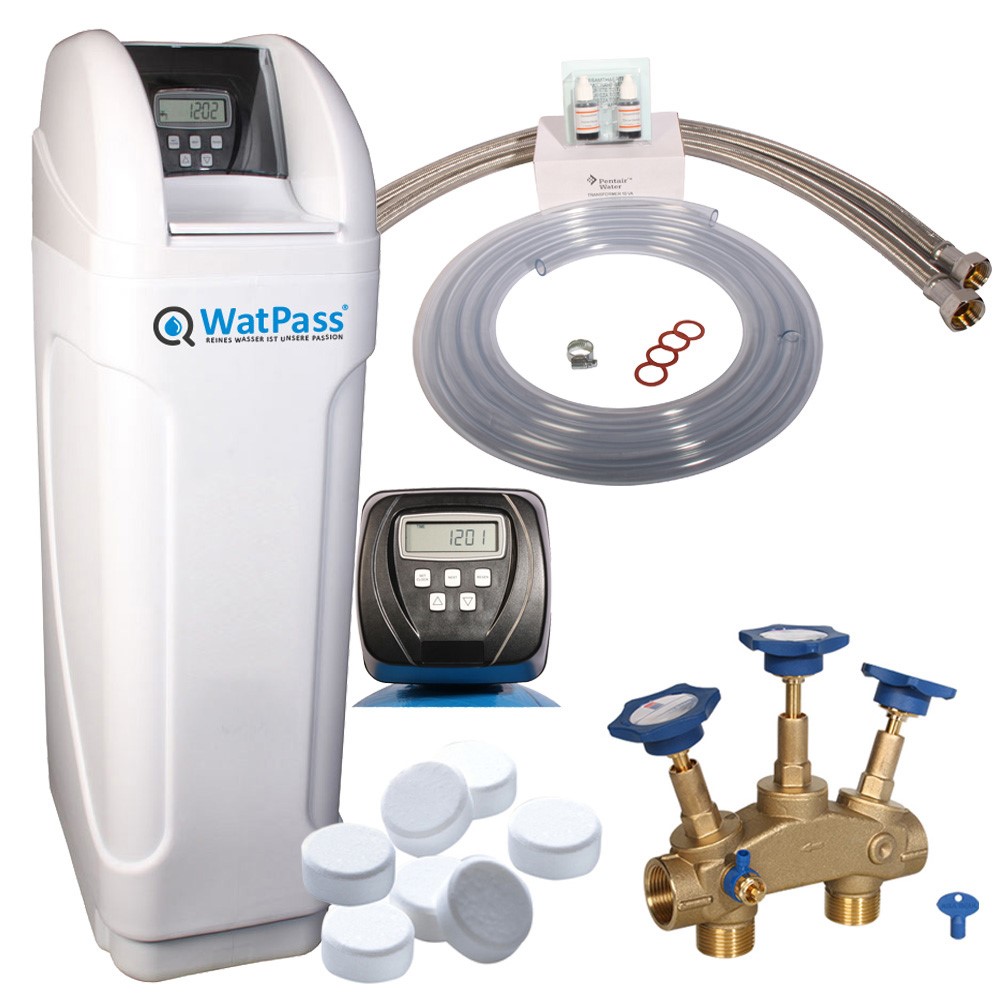
Trinkwasser Entkalkungsanlage / Enthärtungsanlage in einem Kabinettgehäuse mit englischer Menüführung, monochromes Disyplay & Steuerkopf aus dem Hause Clack. Die WatPass® Enthärtungsanlagen sind eine echte Innovation. Sie arbeiten nach dem Ionenaustausch-Verfahren. Dieses Verfahren ist das Etablierteste, zur Wasserenthärtung. Unsere Anlagen sind in 2 Varianten lieferbar: 1. Standardbesalzung für normale Haushalte Bestes sensorisches Ergebniss und ausreichende Enthärtung für den gesamten Haushalt. Die WatPass® Kalk ist dabei besonders energiesparend! Durch Besalzung wird das Regeneriersalz optimal genutzt. Sollten Sie die Anlage für technische Anwendungen benutzen, bitte bei der Verschneidung folgende Werte beachten. Ein einwandfreies Spülergebnis für Gläser erhalten Sie bei Werten von < 150µS/cm und bei Bestecken sollte die Anlage auf < 80 µS/cm eingestellt werden. Ihre Vorteile: • keine verkalkten Heizstäbe & Sprühdüsen • bessere Energieausnutzung der Geräte 2. Schweizer Ausführung Für den Betrieb in der Schweiz ist die SVGW Vorschrift zu beachten. Daher werden die Anlagen für die Schweiz mit Nylon Schutzstrumpf und Silberharzanteil ausgeliefert. Ansonsten ist die Anlage wie die Standardausführung ausgelegt! Nylon-Schutzstrumpf/ Feinsalz: Normalerweise werden Enthärtungsanlagen in der Schweiz mit Feinsalz anstatt mit Salztabletten befahren. Enthärtungsanlagen die wir in die Schweiz liefern, werden daher von uns mit einem Nylon Schutzstrumpf ausgestattet, so das Sie die Enthärtungsanlagen mit Feinsalz betreiben können. Dadurch wird ein verblocken des Salzes in der Anlage ausgeschlossen. Silberharzanteil ( min 2% ): Im Ionenautauscherharz muss ein Minimum von 2% Silberharzanteil enthalten sein. Regeneration mit Ionenaustauscherharz – wie geht das? Wenn hartes Wasser über das Harz geleitet wird, werden die im Wasser vorhandenen Calcium- und Magnesium-Ionen (Ca2+ / Mg2+) gegen die am Harz befindlichen Natrium-Ionen (Na+) ausgetauscht. Das von uns eingesetzte Harz besitzt eine Lebensdauer von über 20 Jahren. Ihre Vorteile Weicheres Wasser schont Ihre Installationen, die Heizungsanlage, Waschmaschinen und Kleingeräte wie Wasserkocher und Kaffeemaschinen. Auf Ihrer Duschabtrennung, den Waschtischen, Toiletten usw. vermindern sich die Kalkbeläge stark. Sie können erhebliche Mengen an Waschmittel, Seifen und Shampoo einsparen und das Wasser schmeckt einfach besser. Insbesondere Teeliebhaber, Kaffeetrinker und ambitionierte Hobbyköche werden das Ergebnis von enthärtetem Wasser zu schätzen wissen. Wer einmal eine Wasserenthärtungsanlage eingesetzt hat, möchte darauf nie wieder verzichten. Wann ist der Einsatz einer Wasserenthärtungsanlage sinnvoll? Die DIN 1988-200 empfiehlt in Tabelle 6 oberhalb eines Härtegrades von 2,5 mol/m³ ( 14 °dH) auch für Trinkwasser kalt die Härtestabilisierung oder Enthärtung. Dabei wird das Wasser zu Trinkwasserzwecken nicht voll enthärtet, sondern mittels des Montageblocks auf eine Wasserhärte von ca. 6-7° dH, wenn technisch möglich, verschnitten. Ist das Wasser noch weicher, kann es korrosiv werden und stellt somit ein Problem für die Installationen dar. Ausserdem schmeckt es dann auch nicht so gut. Aufbau der Enthärtungsanlagen WatPass® Ein Kabinettgehäuse mit abnehmbarem Deckel, in dem einen GFK Druckflasche (gefüllt mit Ionenaustauscherharz) sitzt, bilden die Basis für das extrem wartungsarme Clack Steuerventil mit Display und englischer Bedienung. Die Anlage ist natürlich mengengesteuert. Das innovative Ventil lässt sich komplett werkzeuglos zerlegen und warten. Regeneration – was ist das? Wird das voreingestellte Volumen an Weichwasserdurchfluss erreicht, wird die Regeneration des Harzes um 02:00 Uhr nachts ausgelöst. Eine Reservekapazität wird von uns als Sicherheitsfaktor im Gerät programmiert, so dass kalkfreies Wasser nach Erreichen der voreingestellten Wasserkapazität, bis zur Regeneration zur Verfügung steht. Bei der Regeneration leitet die Enthärtungsanlage automatisch Kochsalzlösung (Natriumchlorid) über das Ionenaustauscher-Harz. Bei diesem Vorgang wird das Harz wieder mit Natrium-Ionen (Na+) behaftet. Die Calcium- und Magnesium-Ionen (Ca2+ / Mg2+) werden mit der Salzlösung über einen separaten Abflussanschluss abgeleitet. Nun ist das Harz zur erneuten Enthärtung Ihres Trinkwassers wieder einsatzbereit. Während der Regeneration liefert die WatPass® 10000 unbehandeltes Leitungswasser, so dass die Wasserversorgung gegeben ist. Bei Inaktivität der Anlage (z.B. Urlaub) wird alle 10 Tage eine Zwangsregeneration ausgelöst um die Verkeimung des Harzbettes zu verhindern. Wie lange reicht eine Füllung Salz? Abhängig von der Wasserhärte und Ihrem Wasserverbrauch reicht eine Füllung ungefähr 3-4 Monate, dann muss neues Salz nachgefüllt werden. Das integriertes Sicherheitsschwimmerventil schützt Sie vor überlaufendem Wasser Anlagengrösse und technische Informationen Für Haushalte bis zu: 1-3 Personen Wasserenthärtungsanlage WatPass® Kalk 3200 mit Mengensteuerung Steuerventil: Clack WS 1 Cl mit monochromen Display und englischer Menüführung (mengengesteuert) Kapazität bei 10°dH.: 3.200 ltr. Kapazität bei 15°dH.: 2.130 ltr. Kapazität bei 20°dH.: 1.600 ltr. Drucktanktyp: 8x17 Harzinhalt: 8 Liter Salzverbrauch je Regeneration: ca. 1,28 KG Regenerationsdauer: ca 60 min Salzvorrat.: 40 KG Blockmaß (HxBxT): 670 x 320 x 500 mm Gewicht: 13 Kg Die WatPass® Kalk 3200 Enthärtungsanlage besteht aus: Ein Kabinettgehäuse für einen Salzvorrat. Einem mengengesteuertem Zentralsteuerventil Typ Clack WS 1 CI, mit englischer Menüführung und monochromen Display. In der Anlage integriert, eine GFK- Druckflasche die mit hochwertigem Ionenaustauscherharz gefüllt ist. Einbaubedingungen für alle Anlagengrößen: Trink- oder Rohwasseranschluss Steckdose 230 V / 50 Hz Abwasseranschluss Druckminderer bei > 6 bar Hauswasserfilter am Eingang Anschlussgewinde: 1 Zoll frostfreier Aufstellort Für die Installationen nach DVGW Richtlinien ist, nach Wunsch, ein DVGW zertifizierter Rohrtrenner käuflich erhältlich (nicht bei eigenem Brunnen erforderlich). Die Anlage wird per Spedition geliefert. Bitte teilen Sie uns bei Bestellung unbedingt eine Telefonnummer mit unter der Sie bei Anlieferung erreichbar sind. Lieferumfang: 1x Enthärtungsanlage, 1x Montageblock, 1x Anschlussset bestehend aus 2 Panzerschläuchen (Länge: 1 Meter), 1 Abflussschlauch (Länge: 2 Meter), 1 Schlauchschelle, 1 Doppel-Härtemessbesteck, 1 Überlaufschlauch (Länge 2 Meter), 1x 25 kg Regeneriersalz
Trinkwassser Enthärtungsanlage in einem Kabinettgehäuse mit englischer Menüführung, monochrom Display zum schnelleren erkennen der Betriebszustände & Steuerkopf aus dem Hause Clack. Die WatPass® Enthärtungsanlagen sind eine echte Innovation. Sie arbeiten nach dem Ionenaustausch-Verfahren. Dieses Verfahren ist das Etablierteste, zur Wasserenthärtung. Unsere Anlagen sind in 2 Varianten lieferbar: 1. Standardbesalzung für normale Haushalte Bestes sensorisches Ergebniss und ausreichende Enthärtung für den gesamten Haushalt. Die WatPass® Kalk ist dabei besonders energiesparend! Durch Besalzung wird das Regeneriersalz optimal genutzt. Sollten Sie die Anlage für technische Anwendungen benutzen, bitte bei der Verschneidung folgende Werte beachten. Ein einwandfreies Spülergebnis für Gläser erhalten Sie bei Werten von < 150 µS/cm und bei Bestecken sollte die Anlage auf < 80 µ?S/cm eingestellt werden. Ihre Vorteile: • keine verkalkten Heizstäbe & Sprühdüsen • bessere Energieausnutzung der Geräte 2. Schweizer Ausführung Für den Betrieb in der Schweiz ist die SVGW Vorschrift zu beachten. Daher werden die Anlagen für die Schweiz mit Nylon Schutzstrumpf und Silberharzanteil ausgeliefert. Ansonsten ist die Anlage wie die Standardausführung ausgelegt! Nylon-Schutzstrumpf/ Feinsalz: Normalerweise werden Enthärtungsanlagen in der Schweiz mit Feinsalz anstatt mit Salztabletten befahren. Enthärtungsanlagen die wir in die Schweiz liefern, werden daher von uns mit einem Nylon Schutzstrumpf ausgestattet, so das Sie die Enthärtungsanlagen mit Feinsalz betreiben können. Dadurch wird ein verblocken des Salzes in der Anlage ausgeschlossen. Silberharzanteil ( min 2% ): Im Ionenautauscherharz muss ein Minimum von 2% Silberharzanteil enthalten sein. Regeneration mit Ionenaustauscherharz – wie geht das? Wenn hartes Wasser über das Harz geleitet wird, werden die im Wasser vorhandenen Calcium- und Magnesium-Ionen (Ca2+ / Mg2+) gegen die am Harz befindlichen Natrium-Ionen (Na+) ausgetauscht. Das von uns eingesetzte Harz besitzt eine Lebensdauer von über 20 Jahren. Ihre Vorteile Weicheres Wasser schont Ihre Installationen, die Heizungsanlage, Waschmaschinen und Kleingeräte wie Wasserkocher und Kaffeemaschinen. Auf Ihrer Duschabtrennung, den Waschtischen, Toiletten usw. vermindern sich die Kalkbeläge stark. Sie können erhebliche Mengen an Waschmittel, Seifen und Shampoo einsparen und das Wasser schmeckt einfach besser. Insbesondere Teeliebhaber, Kaffeetrinker und ambitionierte Hobbyköche werden das Ergebnis von enthärtetem Wasser zu schätzen wissen. Wer einmal eine Wasserenthärtungsanlage eingesetzt hat, möchte darauf nie wieder verzichten. Wann ist der Einsatz einer Wasserenthärtungsanlage sinnvoll? Die DIN 1988-200 empfiehlt in Tabelle 6 oberhalb eines Härtegrades von 2,5 mol/m³ ( 14 °dH) auch für Trinkwasser kalt die Härtestabilisierung oder Enthärtung. Dabei wird das Wasser zu Trinkwasserzwecken nicht voll enthärtet, sondern mittels des Montageblocks auf eine Wasserhärte von ca. 6-7° dH, wenn technisch möglich, verschnitten. Ist das Wasser noch weicher, kann es korrosiv werden und stellt somit ein Problem für die Installationen dar. Ausserdem schmeckt es dann auch nicht so gut. Aufbau der Enthärtungsanlagen WatPass® Ein Kabinettgehäuse mit abnehmbarem Deckel, in dem einen GFK Druckflasche (gefüllt mit Ionenaustauscherharz) sitzt, bilden die Basis für das extrem wartungsarme Clack Steuerventil mit monochrom Display und englischer Bedienung. Die Anlage ist natürlich mengengesteuert. Das innovative Ventil lässt sich komplett werkzeuglos zerlegen und warten. Regeneration – was ist das? Wird das voreingestellte Volumen an Weichwasserdurchfluss erreicht, wird die Regeneration des Harzes um 02:00 Uhr nachts ausgelöst. Eine Reservekapazität wird von uns als Sicherheitsfaktor im Gerät programmiert, so dass kalkfreies Wasser nach Erreichen der voreingestellten Wasserkapazität, bis zur Regeneration zur Verfügung steht. Bei der Regeneration leitet die Enthärtungsanlage automatisch Kochsalzlösung (Natriumchlorid) über das Ionenaustauscher-Harz. Bei diesem Vorgang wird das Harz wieder mit Natrium-Ionen (Na+) behaftet. Die Calcium- und Magnesium-Ionen (Ca2+ / Mg2+) werden mit der Salzlösung über einen separaten Abflussanschluss abgeleitet. Nun ist das Harz zur erneuten Enthärtung Ihres Trinkwassers wieder einsatzbereit. Während der Regeneration liefert die WatPass® 10000 unbehandeltes Leitungswasser, so dass die Wasserversorgung gegeben ist. Bei Inaktivität der Anlage (z.B. Urlaub) wird alle 10 Tage eine Zwangsregeneration ausgelöst um die Verkeimung des Harzbettes zu verhindern. Wie lange reicht eine Füllung Salz? Abhängig von der Wasserhärte und Ihrem Wasserverbrauch reicht eine Füllung ungefähr 3-4 Monate, dann muss neues Salz nachgefüllt werden. Das integriertes Sicherheitsschwimmerventil schützt Sie vor überlaufendem Wasser Anlagengrösse und technische Informationen Für Haushalte bis zu: 3-5 Personen Wasserenthärtungsanlage WatPass® Kalk 6000 mit Mengensteuerung Steuerventil: Clack WS 1 Cl mit monochrom Display und englischer Menüführung (mengengesteuert) Kapazität bei 10°dH.: 6.000 ltr. Kapazität bei 15°dH.: 4.000 ltr. Kapazität bei 20°dH.: 3.000 ltr. Drucktanktyp: 8x35 Harzinhalt: 15 Liter Salzverbrauch je Regeneration ca.: 2,40 KG Regenerationsdauer: ca 60 min Salzvorrat.: 70 KG Blockmaß (HxBxT): 1.140 x 320 x 500 mm Gewicht: 25 Kg Die WatPass® Kalk 6000 Enthärtungsanlage besteht aus: Ein Kabinettgehäuse für einen Salzvorrat. Einem mengengesteuertem Zentralsteuerventil Typ Clack WS 1 Cl, mit englischer Menüführung und monochrom Display. In der Anlage integriert, eine GFK- Druckflasche die mit hochwertigem Ionenaustauscherharz gefüllt ist. Einbaubedingungen für alle Anlagengrößen: Trink- oder Rohwasseranschluss Steckdose 230 V / 50 Hz Abwasseranschluss Druckminderer bei > 6 bar Hauswasserfilter am Eingang Anschlussgewinde: 1 Zoll frostfreier Aufstellort Für die Installationen nach DVGW Richtlinien ist, nach Wunsch, ein DVGW zertifizierter Rohrtrenner käuflich erhältlich (nicht bei eigenem Brunnen erforderlich). Die Anlage wird per Spedition geliefert. Bitte teilen Sie uns bei Bestellung unbedingt eine Telefonnummer mit unter der Sie bei Anlieferung erreichbar sind. Lieferumfang: 1x Enthärtungsanlage, 1x Montageblock, 1x Anschlussset bestehend aus 2 Panzerschläuchen (Länge: 1 Meter), 1 Abflussschlauch (Länge: 2 Meter), 1 Schlauchschelle, 1 Doppel-Härtemessbesteck, 1 Überlaufschlauch (Länge 2 Meter)
Trinkwassser Enthärtungsanlage in einem Kabinettgehäuse mit englischer Menüführung, monochrom Display und Steuerkopf aus dem Hause Clack. Die WatPass® Enthärtungsanlagen sind eine echte Innovation. Sie arbeiten nach dem Ionenaustausch-Verfahren. Dieses Verfahren ist das Etablierteste, zur Wasserenthärtung. Unsere Anlagen sind in 2 Varianten lieferbar: 1. Standardbesalzung für normale Haushalte Bestes sensorisches Ergebniss und ausreichende Enthärtung für den gesamten Haushalt. Die WatPass® Kalk ist dabei besonders energiesparend! Durch Besalzung wird das Regeneriersalz optimal genutzt. Sollten Sie die Anlage für technische Anwendungen benutzen, bitte bei der Verschneidung folgende Werte beachten. Ein einwandfreies Spülergebnis für Gläser erhalten Sie bei Werten von < 150 µS/cm und bei Bestecken sollte die Anlage auf < 80 µS/cm eingestellt werden. Ihre Vorteile: • keine verkalkten Heizstäbe & Sprühdüsen • bessere Energieausnutzung der Geräte 2. Schweizer Ausführung Für den Betrieb in der Schweiz ist die SVGW Vorschrift zu beachten. Daher werden die Anlagen für die Schweiz mit Nylon Schutzstrumpf und Silberharzanteil ausgeliefert. Ansonsten ist die Anlage wie die Standardausführung ausgelegt! Nylon-Schutzstrumpf/ Feinsalz: Normalerweise werden Enthärtungsanlagen in der Schweiz mit Feinsalz anstatt mit Salztabletten befahren. Enthärtungsanlagen die wir in die Schweiz liefern, werden daher von uns mit einem Nylon Schutzstrumpf ausgestattet, so das Sie die Enthärtungsanlagen mit Feinsalz betreiben können. Dadurch wird ein verblocken des Salzes in der Anlage ausgeschlossen. Silberharzanteil ( min 2% ): Im Ionenautauscherharz muss ein Minimum von 2% Silberharzanteil enthalten sein. Regeneration mit Ionenaustauscherharz – wie geht das? Wenn hartes Wasser über das Harz geleitet wird, werden die im Wasser vorhandenen Calcium- und Magnesium-Ionen (Ca2+ / Mg2+) gegen die am Harz befindlichen Natrium-Ionen (Na+) ausgetauscht. Das von uns eingesetzte Harz besitzt eine Lebensdauer von über 20 Jahren. Ihre Vorteile Weicheres Wasser schont Ihre Installationen, die Heizungsanlage, Waschmaschinen und Kleingeräte wie Wasserkocher und Kaffeemaschinen. Auf Ihrer Duschabtrennung, den Waschtischen, Toiletten usw. vermindern sich die Kalkbeläge stark. Sie können erhebliche Mengen an Waschmittel, Seifen und Shampoo einsparen und das Wasser schmeckt einfach besser. Insbesondere Teeliebhaber, Kaffeetrinker und ambitionierte Hobbyköche werden das Ergebnis von enthärtetem Wasser zu schätzen wissen. Wer einmal eine Wasserenthärtungsanlage eingesetzt hat, möchte darauf nie wieder verzichten. Wann ist der Einsatz einer Wasserenthärtungsanlage sinnvoll? Die DIN 1988-200 empfiehlt in Tabelle 6 oberhalb eines Härtegrades von 2,5 mol/m³ ( 14 °dH) auch für Trinkwasser kalt die Härtestabilisierung oder Enthärtung. Dabei wird das Wasser zu Trinkwasserzwecken nicht voll enthärtet, sondern mittels des Montageblocks auf eine Wasserhärte von ca. 6-7° dH, wenn technisch möglich, verschnitten. Ist das Wasser noch weicher, kann es korrosiv werden und stellt somit ein Problem für die Installationen dar. Ausserdem schmeckt es dann auch nicht so gut. Aufbau der Enthärtungsanlagen WatPass® Ein Kabinettgehäuse mit abnehmbarem Deckel, in dem einen GFK Druckflasche (gefüllt mit Ionenaustauscherharz) sitzt, bilden die Basis für das extrem wartungsarme Clack Steuerventil mit monochrom Display und deutscher Bedienung. Das ist eine echte Innovation und erleichtert Ihnen den Umgang mit der Anlage um einiges. Die Anlage ist natürlich mengengesteuert. Das innovative Ventil lässt sich komplett werkzeuglos zerlegen und warten. Regeneration – was ist das? Wird das voreingestellte Volumen an Weichwasserdurchfluss erreicht, wird die Regeneration des Harzes um 02:00 Uhr nachts ausgelöst. Eine Reservekapazität wird von uns als Sicherheitsfaktor im Gerät programmiert, so dass kalkfreies Wasser nach Erreichen der voreingestellten Wasserkapazität, bis zur Regeneration zur Verfügung steht. Bei der Regeneration leitet die Enthärtungsanlage automatisch Kochsalzlösung (Natriumchlorid) über das Ionenaustauscher-Harz. Bei diesem Vorgang wird das Harz wieder mit Natrium-Ionen (Na+) behaftet. Die Calcium- und Magnesium-Ionen (Ca2+ / Mg2+) werden mit der Salzlösung über einen separaten Abflussanschluss abgeleitet. Nun ist das Harz zur erneuten Enthärtung Ihres Trinkwassers wieder einsatzbereit. Während der Regeneration liefert die WatPass® 10000 unbehandeltes Leitungswasser, so dass die Wasserversorgung gegeben ist. Bei Inaktivität der Anlage (z.B. Urlaub) wird alle 10 Tage eine Zwangsregeneration ausgelöst um die Verkeimung des Harzbettes zu verhindern. Wie lange reicht eine Füllung Salz? Abhängig von der Wasserhärte und Ihrem Wasserverbrauch reicht eine Füllung ungefähr 3-4 Monate, dann muss neues Salz nachgefüllt werden. Das integriertes Sicherheitsschwimmerventil schützt Sie vor überlaufendem Wasser Anlagengrösse und technische Informationen Für Haushalte bis zu: 5-8 Personen Wasserenthärtungsanlage WatPass® Kalk 10000 mit Mengensteuerung Steuerventil: Clack WS 1 Cl mit monochrom Display und englischer Menüführung (mengengesteuert) Kapazität bei 10°dH.: 10.000 ltr. Kapazität bei 15°dH.: 6.660 ltr. Kapazität bei 20°dH.: 5.000 ltr. Drucktanktyp: 9x35 Harzinhalt: 25 Liter Salzverbrauch je Regeneration: ca. 4,0 KG Regenerationsdauer: ca 60 min Salzvorrat.: 70 KG Blockmaß (HxBxT): 1.140 x 320 x 500 mm Gewicht: 35 Kg Die WatPass® Kalk 10000 Enthärtungsanlage besteht aus: Ein Kabinettgehäuse für einen Salzvorrat. Einem mengengesteuertem Zentralsteuerventil Typ Clack WS 1 CI, mit englischer Menüführung und monochrom Display. In der Anlage integriert, eine GFK- Druckflasche die mit hochwertigem Ionenaustauscherharz gefüllt ist. Einbaubedingungen für alle Anlagengrößen: Trink- oder Rohwasseranschluss Steckdose 230 V / 50 Hz Abwasseranschluss Druckminderer bei > 6 bar Hauswasserfilter am Eingang Anschlussgewinde: 1 Zoll frostfreier Aufstellort Für die Installationen nach DVGW Richtlinien ist, nach Wunsch, ein DVGW zertifizierter Rohrtrenner käuflich erhältlich (nicht bei eigenem Brunnen erforderlich). Die Anlage wird per Spedition geliefert. Bitte teilen Sie uns bei Bestellung unbedingt eine Telefonnummer mit unter der Sie bei Anlieferung erreichbar sind. Lieferumfang: 1x Enthärtungsanlage, 1x Montageblock, 1x Anschlussset bestehend aus 2 Panzerschläuchen (Länge: 1 Meter), 1 Abflussschlauch (Länge: 2 Meter), 1 Schlauchschelle, 1 Doppel-Härtemessbesteck, 1 Überlaufschlauch (Länge 2 Meter), 1x 25 kg Regeneriersalz

Drinking water softening system in a cabinet housing with English menu navigation, monochrome display for faster recognition of operating conditions & control head from Clack. The WatPass® water softening systems are a real innovation. They work according to the ion exchange method. This procedure is the establishment test for water softening. Our systems are available in 2 variants: 1. Standard salting for normal households Best sensory result and adequate softening for the entire household. The WatPass® lime is particularly energy-saving! By salting the regenerating salt is used optimally. If you are using the system for technical applications, please note the following values ??when cutting. A perfect wash result for glasses is available at values ??of <150 ?S / cm and for cutlery, the system should be set to <80 ?S / cm. Your advantages: • no calcified heating rods & spray nozzles • better energy utilization of the devices 2. Swiss version For operation in Switzerland, the SVGW regulation must be observed. Therefore, the systems for Switzerland are supplied with nylon protective sock and silver resin. Otherwise, the system is designed as the standard version! Nylon protective stocking / fine salt: Normally, softening plants in Switzerland are used with fine salt instead of salt tablets. Water softening systems that we deliver to Switzerland are therefore equipped by us with a nylon protective stocking so that you can operate the softening systems with fine salt. As a result, a blocking of the salt in the system is excluded. Silver resin content (min 2%): The ion exchange resin must contain a minimum of 2% silver resin. Regeneration with ion exchange resin - how does it work? When hard water is passed over the resin, the calcium and magnesium ions (Ca2 + / Mg2 +) present in the water are exchanged for the sodium ions (Na +) present on the resin. The resin we use has a lifespan of over 20 years. Your advantages Softer water protects your installations, the heating system, washing machines and small appliances such as kettles and coffee machines. The limescale deposits on your shower enclosure, washbasins, toilets, etc. are greatly reduced. You can save significant amounts of detergent, soaps and shampoo and the water just tastes better. Especially tea lovers, coffee drinkers and ambitious home cooks will appreciate the result of softened water. Anyone who has used a water softening system would never want to do without it again. When does it make sense to use a water softening system? The DIN 1988-200 recommends in Table 6 above a hardness of 2.5 mol / m³ (14 ° dH) for drinking water cold hardness stabilization or softening. The water is not fully softened for drinking water purposes, but by means of the mounting block to a water hardness of about 6-7 ° dH, if technically possible, blended. If the water is even softer, it can become corrosive and thus pose a problem for the installations. Moreover, it does not taste that good either. Construction of water softening systems WatPass® A cabinet housing with removable lid, in which a GFK pressure bottle (filled with ion exchange resin) sits, form the basis for the extremely low-maintenance Clack control valve with monochrome display and English operation. This is a real innovation and makes the handling of the system a lot easier. The system is of course volume controlled. The innovative valve can be disassembled and maintained completely without Tools. Regeneration - what is it? If the pre-set volume of soft water flow is reached, regeneration of the resin will be triggered at 2:00 am. A reserve capacity is programmed by us as a safety factor in the unit, so that lime-free water is available after the pre-set water capacity has been reached, until regeneration. During regeneration, the water softener automatically routes saline (sodium chloride) through the ion-exchange resin. In this process, the resin is again afflicted with sodium ions (Na +). The calcium and magnesium ions (Ca2 + / Mg2 +) are derived with the saline solution via a separate drain port. Now the resin is ready to re-soften your drinking water. During regeneration, the WatPass® 10000 delivers untreated tap water, so that the water supply is given. In case of inactivity of the plant (eg vacation) a compulsory regeneration is triggered every 10 days to prevent the germination of the resin bed. How long does a filling of salt last? Depending on the water hardness and your water consumption, a filling is enough for about 3-4 months, then new salt must be refilled. The integrated safety float valve protects you from overflowing water System size and technical information For households up to: 5-7 persons Water softening system WatPass® Kalk 10000 with volume control Control valve: Clack WS 1 Cl with monochrome display and English menu navigation (quantity-controlled) Capacity at 10 ° dH .: 10,000 ltr. Capacity at 15 ° dH .: 6,660 ltr. Capacity at 20 ° dH .: 5,000 ltr. Pressure Tank Type: 9x35 Resin content: 25 liters Salt consumption per regeneration: approx. 4.0 KG Regeneration duration: approx. 60 min Salt stock .: 70 KG Block dimension (HxWxD): 1,140 x 320 x 500 mm Weight: 35 Kg The WatPass® Kalk 10000 water softening system consists of: A cabinet housing for a salt supply. A volume-controlled central control valve type Clack WS 1 CI, with English menu navigation and monochrome display. Integrated in the system, a GRP pressure bottle filled with high quality ion exchange resin. Installation conditions for all plant sizes: Drinking or raw water connection Socket 230 V / 50 Hz Waste water connection Pressure reducer at> 6 bar Domestic water filter at the entrance Connection thread: 1 inch frost-free installation site If you need a plumber, we can arrange for you a specialized specialist company for the area of Central Germany, where you usually get an appointment within 2-4 weeks. The costs are performance-related and are negotiated by you directly with the executive specialist. Details on the installation situation will be clarified in advance. We receive no commission for the mediation! Please contact us if this service is interesting for you. For the installations according to DVGW guidelines, a DVGW certified pipe separator is available on request (not required for own well). The plant is delivered by freight carrier. Please tell us when ordering necessarily a phone number under which you can be reached on delivery.
Drinking water softening system in a cabinet housing with English menu navigation, monochrome display for faster recognition of operating conditions & control head from Clack. The WatPass® water softening systems are a real innovation. They work according to the ion exchange method. This procedure is the establishment test for water softening. Our systems are available in 2 variants: 1. Standard salting for normal households Best sensory result and adequate softening for the entire household. The WatPass® lime is particularly energy-saving! By salting the regenerating salt is used optimally. If you are using the system for technical applications, please note the following values ??when cutting. A perfect wash result for glasses is available at values ??of <150 µS / cm and for cutlery, the system should be set to <80 µS / cm. Your Advantages: • no calcified heating rods & spray nozzles • better energy utilization of the devices 2. Swiss version For operation in Switzerland, the SVGW regulation must be observed. Therefore, the systems for Switzerland are supplied with nylon protective sock and silver resin. Otherwise, the system is designed as the standard Version! Nylon protective stocking / fine salt: Normally, softening plants in Switzerland are used with fine salt instead of salt tablets. Water softening systems that we deliver to Switzerland are therefore equipped by us with a nylon protective stocking so that you can operate the softening systems with fine salt. As a result, a blocking of the salt in the system is excluded. Silver resin content (min 2%): The ion exchange resin must contain a minimum of 2% silver resin. Regeneration with ion exchange resin - how does it work? When hard water is passed over the resin, the calcium and magnesium ions (Ca2 + / Mg2 +) present in the water are exchanged for the sodium ions (Na +) present on the resin. The resin we use has a lifespan of over 20 years. Your advantages Softer water protects your installations, the heating system, washing machines and small appliances such as kettles and coffee machines. The limescale deposits on your shower enclosure, washbasins, toilets, etc. are greatly reduced. You can save significant amounts of detergent, soaps and shampoo and the water just tastes better. Especially tea lovers, coffee drinkers and ambitious home cooks will appreciate the result of softened water. Anyone who has used a water softening system would never want to do without it again. When does it make sense to use a water softening system? The DIN 1988-200 recommends in Table 6 above a hardness of 2.5 mol / m³ (14 ° dH) for drinking water cold hardness stabilization or softening. The water is not fully softened for drinking water purposes, but by means of the mounting block to a water hardness of about 6-7 ° dH, if technically possible, blended. If the water is even softer, it can become corrosive and thus pose a problem for the installations. Moreover, it does not taste that good either. Construction of water softening systems WatPass® A cabinet housing with removable lid, in which a GFK pressure bottle (filled with ion exchange resin) sits, form the basis for the extremely low-maintenance Clack control valve with monochrome display and englisch operation. The system is of course volume controlled. The innovative valve can be disassembled and maintained completely without tools. Regeneration - what is it? If the pre-set volume of soft water flow is reached, regeneration of the resin will be triggered at 2:00 am. A reserve capacity is programmed by us as a safety factor in the unit, so that lime-free water is available after the pre-set water capacity has been reached, until regeneration. During regeneration, the water softener automatically routes saline (sodium chloride) through the ion-exchange resin. In this process, the resin is again afflicted with sodium ions (Na +). The calcium and magnesium ions (Ca2 + / Mg2 +) are derived with the saline solution via a separate drain port. Now the resin is ready to re-soften your drinking water. During regeneration, the WatPass® 320 delivers untreated tap water, so that the water supply is given. In case of inactivity of the plant (eg vacation) a compulsory regeneration is triggered every 10 days to prevent the germination of the resin bed. How long does a filling of salt last? Depending on the water hardness and your water consumption, a filling is enough for about 3-4 months, then new salt must be refilled. The integrated safety float valve protects you from overflowing water. System size and technical information For households up to: 1-3 persons Water softening system WatPass® Kalk 3200 with volume control Control valve: Clack WS 1 Cl with monochrome display and German menu navigation (quantity-controlled) Capacity at 10 ° dH .: 3,200 ltr. Capacity at 15 ° dH .: 2,130 ltr. Capacity at 20 ° dH .: 1,600 ltr. Pressure Tank Type: 8x17 Resin content: 8 liters Salt consumption per regeneration: approx. 1.28 KG Regeneration duration: approx. 60 min Salt stock .: 40 KG Block dimension (HxWxD): 670 x 320 x 500 mm Weight: 13 Kg The WatPass® Kalk 320 water softening system consists of: A cabinet housing for a salt supply. A volume-controlled central control valve type Clack WS 1 CI, with English menu navigation and monochrome display. Integrated in the system, a GRP pressure bottle filled with high quality ion exchange resin. Installation conditions for all plant sizes: Drinking or raw water connection Socket 230 V / 50 Hz Waste water connection Pressure reducer at> 6 bar Domestic water filter at the entrance Connection thread: 1 inch frost-free installation site If you need a plumber, we can arrange for you a specialized specialist company for the area of Central Germany, where you usually get an appointment within 2-4 weeks. The costs are performance-related and are negotiated by you directly with the executive specialist. Details on the installation situation will be clarified in advance. We receive no commission for the mediation! Please contact us if this service is interesting for you. For the installations according to DVGW guidelines, a DVGW certified pipe separator is available on request (not required for own well). The plant is delivered by freight carrier. Please tell us when ordering necessarily a phone number under which you can be reached on delivery.
Drinking water softening system in a cabinet housing with English menu navigation, for faster recognition of operating conditions & control head from Clack. The WatPass® water softening systems are a real innovation. They work according to the ion exchange method. This procedure is the establishment test for water softening. Our systems are available in 2 variants: 1. Standard salting for normal households Best sensory result and adequate softening for the entire household. The WatPass® lime is particularly energy-saving! By salting the regenerating salt is used optimally. If you are using the system for technical applications, please note the following values ??when cutting. A perfect wash result for glasses is available at values ??of <150 µS / cm and for cutlery, the system should be set to <80 µS / cm. Your advantages: • no calcified heating rods & spray nozzles • better energy utilization of the devices 2. Swiss version For operation in Switzerland, the SVGW regulation must be observed. Therefore, the systems for Switzerland are supplied with nylon protective sock and silver resin. Otherwise, the system is designed as the standard version! Nylon protective stocking / fine salt: Normally, softening plants in Switzerland are used with fine salt instead of salt tablets. Water softening systems that we deliver to Switzerland are therefore equipped by us with a nylon protective stocking so that you can operate the softening systems with fine salt. As a result, a blocking of the salt in the system is excluded. Silver resin content (min 2%): The ion exchange resin must contain a minimum of 2% silver resin. Regeneration with ion exchange resin - how does it work? When hard water is passed over the resin, the calcium and magnesium ions (Ca2 + / Mg2 +) present in the water are exchanged for the sodium ions (Na +) present on the resin. The resin we use has a lifespan of over 20 years. Your advantages Softer water protects your installations, the heating system, washing machines and small appliances such as kettles and coffee machines. The limescale deposits on your shower enclosure, washbasins, toilets, etc. are greatly reduced. You can save significant amounts of detergent, soaps and shampoo and the water just tastes better. Especially tea lovers, coffee drinkers and ambitious home cooks will appreciate the result of softened water. Anyone who has used a water softening system would never want to do without it again. When does it make sense to use a water softening system? The DIN 1988-200 recommends in Table 6 above a hardness of 2.5 mol / m³ (14 ° dH) for drinking water cold hardness stabilization or softening. The water is not fully softened for drinking water purposes, but by means of the mounting block to a water hardness of about 6-7 ° dH, if technically possible, blended. If the water is even softer, it can become corrosive and thus pose a problem for the installations. Moreover, it does not taste that good either. Construction of water softening systems WatPass® A cabinet housing with removable lid, in which a GFK pressure bottle (filled with ion exchange resin) sits, form the basis for the extremely low-maintenance Clack control valve with and english operation. The system is of course volume controlled. The innovative valve can be disassembled and maintained completely without tools. Regeneration - what is it? If the pre-set volume of soft water flow is reached, regeneration of the resin will be triggered at 2:00 am. A reserve capacity is programmed by us as a safety factor in the unit, so that lime-free water is available after the pre-set water capacity has been reached, until regeneration. During regeneration, the water softener automatically routes saline (sodium chloride) through the ion-exchange resin. In this process, the resin is again afflicted with sodium ions (Na +). The calcium and magnesium ions (Ca2 + / Mg2 +) are derived with the saline solution via a separate drain port. Now the resin is ready to re-soften your drinking water. During regeneration, the WatPass® 6000 delivers untreated tap water, so that the water supply is given. In case of inactivity of the plant (eg vacation) a compulsory regeneration is triggered every 10 days to prevent the germination of the resin bed. How long does a filling of salt last? Depending on the water hardness and your water consumption, a filling is enough for about 3-4 months, then new salt must be refilled. The integrated safety float valve protects you from overflowing water System size and technical information Water softening system WatPass®-6000 with volume control Control valve: Clack WS 1 Cl Capacity at 10 ° dH .: 6,000 ltr. Capacity at 15 ° dH .: 4.000 ltr. Capacity at 20 ° dH .: 3,000 ltr. Pressure Tank Type: 8x35 Resin content: 15 liters Salt consumption per regeneration approx .: 2,40 KG Regeneration duration: approx. 60 min Salt stock .: 70 KG Block dimension (HxWxD): 1,140 x 320 x 500 mm Weight: 25 Kg The WatPass® Kalk 6000 water softening system consists of: A cabinet housing for a salt supply. A volume-controlled central control valve type Clack WS 1 CI, with English menu navigation. Integrated in the system, a GRP pressure bottle filled with high quality ion exchange resin. Installation conditions for all plant sizes: Drinking or raw water connection Socket 230 V / 50 Hz Waste water connection Pressure reducer at> 6 bar Domestic water filter at the entrance Connection thread: 1 inch frost-free installation site If you need a plumber, we can arrange for you a specialized specialist company for the area of Central Germany, where you usually get an appointment within 2-4 weeks. The costs are performance-related and are negotiated by you directly with the executive specialist. Details on the installation situation will be clarified in advance. We receive no commission for the mediation! Please contact us if this service is interesting for you. For the installations according to DVGW guidelines, a DVGW certified pipe separator is available on request (not required for own well). The plant is delivered by freight carrier. Please tell us when ordering necessarily a phone number under which you can be reached on delivery.